

New Delhi, Sep 09: The Pradhan Mantri Schools for Rising India (PM SHRI) Scheme has made significant progress towards its target of developing more than 14,500 existing schools as exemplar institutions aligned with the vision of the National Education Policy (NEP) 2020, with 13,092 schools selected across 36 States and Union Territories as of July 2026.
Launched on September 7, 2022, the Centrally Sponsored Scheme is being implemented by the Department of School Education and Literacy, Ministry of Education, with a total project cost of ₹27,360 crore for the period 2022–23 to 2026–27.
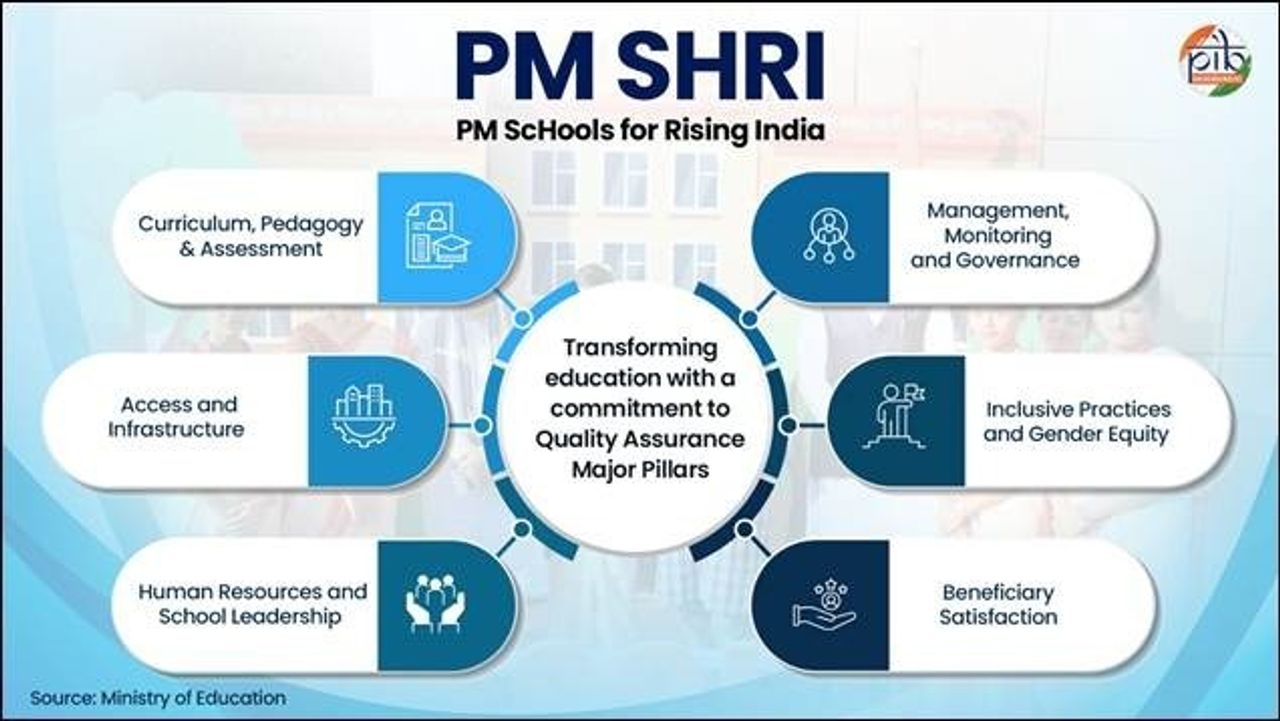
The initiative seeks to transform selected schools into model institutions by strengthening infrastructure, pedagogy, inclusion and sustainability, while equipping students with 21st-century skills. The selected schools are also envisaged as mentor institutions for neighbouring schools, sharing best practices through mentoring, handholding, collaboration and clustering.
According to the Ministry, the 13,092 selected schools represent around 90 per cent of the scheme’s envisaged target and are expected to directly benefit more than 20 lakh students. The network includes schools under the Kendriya Vidyalaya Sangathan (KVS), Navodaya Vidyalaya Samiti (NVS) and National Council of Educational Research and Training (NCERT).
The scheme has a Central share of ₹18,128 crore. The approved Project Approval Board outlay increased from ₹2,520 crore in 2023–24 to ₹5,224 crore in 2026–27, marking an increase of around 107 per cent.
PM SHRI schools are designed to promote inclusive, equitable and joyful learning, with emphasis on experiential and learner-centred education. They also focus on green and sustainable practices, quality infrastructure, improved learning outcomes, technology-enabled education and exposure to future-ready skills.
The initiative promotes experiential learning through activities such as bagless days, internships with local artisans, study of local arts and traditions, and preservation of indigenous knowledge. It also encourages the use of mother tongue and local or regional languages, particularly in the early grades.
Technology-enabled learning is another key component, with schools being supported through ICT facilities, smart classrooms, internet connectivity, digital learning platforms and STEM-based programmes. These interventions aim to strengthen digital literacy, critical thinking and problem-solving abilities among students.
The PM SHRI network currently covers 725 districts and 8,340 blocks/ULBs. Of the 13,092 selected schools, 1,305 are primary, 3,102 upper primary, 3,141 secondary and 5,544 higher secondary schools. The network also includes 80 Kasturba Gandhi Balika Vidyalayas, 913 KVS schools, 620 NVS schools and four NCERT schools.
Selection of schools is carried out through a three-stage Challenge Mode based on prescribed quality benchmarks. The process involves signing of an MoU with the Centre, identification of eligible schools using UDISE+ data, and selection through a challenge-based assessment followed by physical verification.
For the Challenge Method, schools in urban areas are required to secure a minimum score of 70 per cent, while those in rural areas require at least 60 per cent. The assessment covers infrastructure, learning outcomes, pedagogy, PM POSHAN, vocational education, green initiatives and stakeholder commitment.
The scheme also focuses on strengthening teacher capacity and school leadership through professional development programmes. Principals receive training in educational leadership and school management, while teachers are trained in areas including competency-based pedagogy, ICT integration, school safety and the Holistic Progress Card.
The government envisages PM SHRI schools as institutions that demonstrate and disseminate innovative educational practices that can be replicated by neighbouring schools, creating a wider impact on the school education system and advancing the vision of an equitable, inclusive and future-ready India.