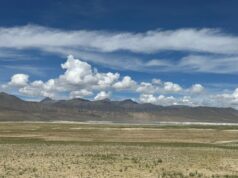
In a major effort for high-altitude ecological restoration, Ladakh Lieutenant Governor Vinai Kumar Saxena launched an ambitious project to revive the rapidly drying Tso Kar Lake in the high-altitude Changthang region of Ladakh. The landmark initiative aims to channelise up to 320 million litres of glacier meltwater daily to restore the Ramsar site to its former scale.
Over the past decade, Tso Kar—once spanning nearly 11,000 acres—has desiccated by almost 70 percent, shrinking to just 3,200 acres. The sharp decline has severely degraded surrounding pastures, disrupted local salt-trading traditions and threatened wildlife habitats, including nesting grounds for the endangered Black-necked Crane.
Tso Kar, one of Ladakh’s iconic high-altitude glacial lakes, once covered nearly 11,000 acres but has now reduced to around 3,200 acres. The shrinking water body has also affected its ecosystem, with a sharp decline in migratory birds, including the famed Black-necked Crane.
The project was conceived after LG Saxena visited Tso Kar on August 10, 2026, where local villagers and the Nambardar informed him about the lake’s rapid decline and the resulting reduction in bird populations and grazing land.
Following the visit, the Lieutenant Governor directed the Public Health Engineering (PHE) Department to conduct a detailed survey. After around 15 days of groundwork, the department submitted its report on August 30, initially proposing an 11-km RCC channel.
However, citing ecological concerns, Saxena directed officials to avoid constructing a new RCC channel and instead use a simple earthen channel to divert the glacier water. With winter approaching and temperatures expected to fall sharply, work was subsequently taken up on a war footing.
The revival of Tso Kar is also expected to benefit local communities, particularly Pashmina goat herders who depend on surrounding grazing lands.
The Rupsho Kharnak stream originates at an altitude of around 18,000 feet, approximately 11 km from Tso Kar. At present, a substantial volume of its glacier meltwater flows unused into the Sindhu River. The administration expects that diverting the water could help restore the lake significantly within a year.
The initiative follows the successful channelisation of around 90 million litres of Stok Glacier water into canals serving Igoo-Phey and Chuchot villages near Leh for irrigation.
Under the Tso Kar revival plan, water from the Rupsho Kharnak stream will be diverted through a series of three natural depressions located along its route towards the lake. The first depression covers around 270 acres, the second 24 acres and the third around 10 acres.
Check dams equipped with three RCC pipes will be constructed at the outlets of each depression to regulate water levels and control downstream flow. Water from the third depression will then be channelised into Tso Kar, located around 400 metres away, using gravity flow.
The administration plans to rely on simple, low-cost earthworks rather than constructing new concrete channels.
Work on the project began on September 2, and from September 9, around 20 cusecs of water has reportedly been successfully diverted into the first depression. The pond has already begun filling rapidly, with around 20 per cent of its area reportedly covered with water within four days.
The project is also expected to create three new freshwater wetlands before the water reaches Tso Kar. These wetlands will allow sediments to settle naturally and ensure that relatively clean water enters the main lake.
Together, the three depressions are expected to hold nearly 1,230 million litres of water. The newly created wetlands, visible from the Leh-Manali Highway, could also become additional tourist attractions while providing new habitats for migratory birds.
Speaking about the initiative, LG VK Saxena said the success of the Stok Glacier project had demonstrated that large-scale and sustainable water management could be achieved in Ladakh’s cold desert through simple engineering solutions.
He said the Rupsho Kharnak project would serve as a model for high-altitude ecological restoration while supporting agriculture, rural livelihoods and long-term climate resilience.
The administration expects the project to combine ecological restoration, tourism development and livelihood support while helping preserve the unique high-altitude ecosystem of Tso Kar for future generations.