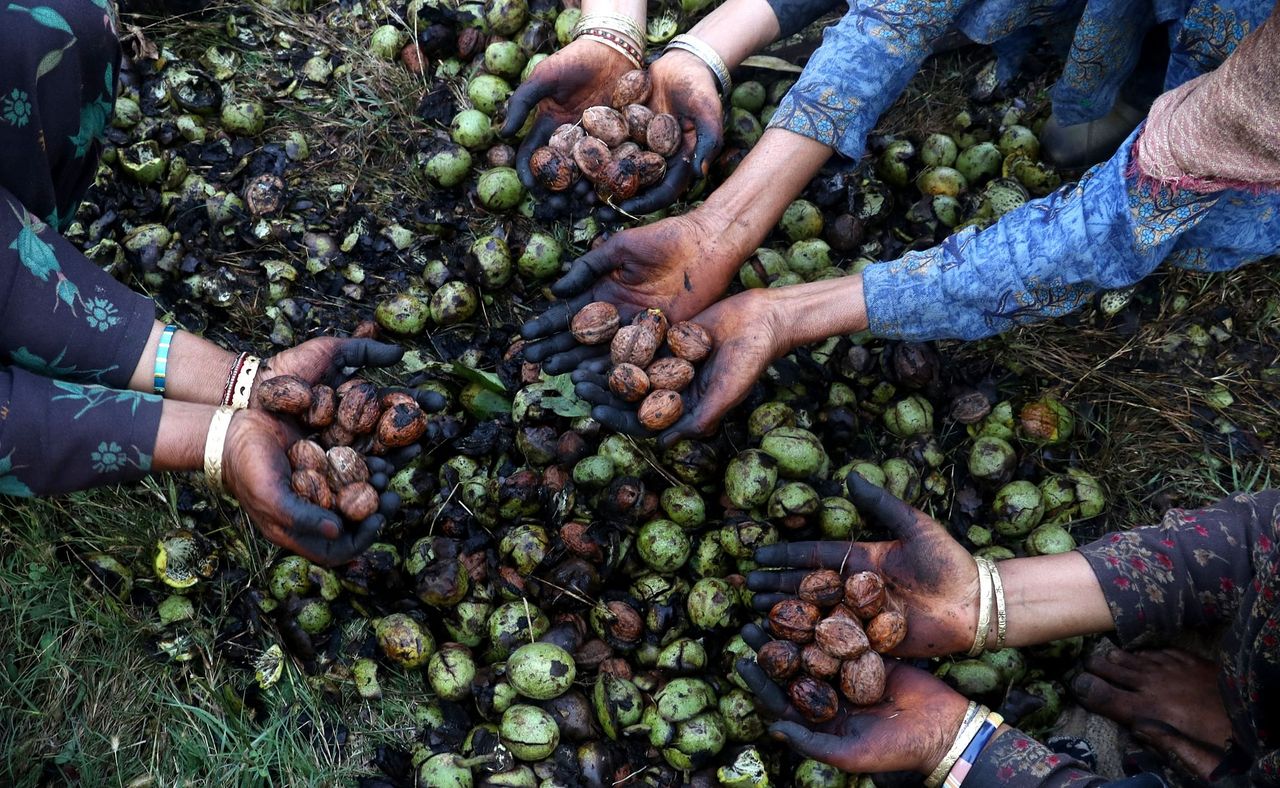

Seven people have died after falling from towering walnut trees during the ongoing harvest season in Kashmir, renewing concerns over the safety of traditional orchards and reviving a debate over replacing ageing trees with high-density plantations.
The recurring accidents have highlighted the risks faced by workers who climb tall walnut trees to harvest the crop, with growers saying the traditional orchard system is becoming increasingly difficult to sustain.
The deaths have also brought renewed attention to long-standing problems in Kashmir’s walnut sector, including ageing trees, declining productivity and restrictions on the felling of existing trees.
Walnut traders and growers have increasingly called for a shift towards high-density plantations, arguing that newer varieties can provide better returns while making orchard management and harvesting easier.
“It is high time to shift to high-density walnut plantation,” said Haji Bahadur Khan, president of the Dry Fruit Association of Kashmir.
Khan said many of the region’s walnut trees had become old and were no longer providing the yields that farmers could expect from newer varieties.
“Ageing trees and low productivity have necessitated their replacement,” Khan said, arguing that growers needed greater flexibility to rejuvenate their orchards.
He said that GST and cheaper imports from Chile, California and other countries had reduced the demand for local produce.
Bilal Ahmad, a walnut farmer from south Kashmir’s Shopian district, said traditional walnut trees also posed challenges because of the amount of land they occupied.
“Traditional walnut trees occupy a large space and their yield is also low,” Ahmad said, adding that high-density plantations could allow farmers to grow more trees on smaller plots and potentially improve returns.
The push for high-density cultivation, however, faces a legal hurdle.
Walnut trees in Kashmir are protected under the Jammu and Kashmir Preservation of Specified Trees Act, 1969. The law requires government permission for their felling and places restrictions on cutting healthy or fruit-bearing trees.
Growers say the restrictions can make it difficult to remove old or unproductive trees and replace them with newer varieties, even when the existing trees have become less commercially viable.
Traditional walnut varieties can take more than a decade to begin bearing fruit and require considerable space as they mature. High-density varieties can start producing in about four to five years and can be planted at closer intervals, potentially allowing farmers to obtain higher yields from smaller holdings.
For growers, the debate is therefore not only about improving productivity but also about reducing the risks associated with harvesting from increasingly tall and ageing trees.
The recent deaths have added urgency to those concerns, with traders and farmers calling for a policy that would allow gradual orchard rejuvenation while protecting the interests of growers.
“The sector needs a transition towards modern plantations,” Khan said, stressing that replacing ageing trees was becoming increasingly important for the future of walnut cultivation in Kashmir.
The challenge for the authorities, growers say, is to balance the protection of walnut trees with the need to modernise orchards and make harvesting safer and economically viable.