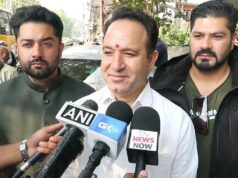


Srinagar, Oct 13: Jammu and Kashmir Waqf Board Chairperson DarakhshanAndrabi’s assertion that no directive has been issued to Imams on Friday sermons has failed to quell the controversy over reports of uniform sermon themes, with Chief Minister Omar Abdullah, People’s Democratic Party (PDP) President Mehbooba Mufti, and the MuttahidaMajlis-e-Ulema (MMU) opposing the reported move and raising concerns over the board’s role in religious affairs.
While Andrabi has defended the proposal to encourage religious leaders to discuss social problems, including drug addiction and suicide, her critics have questioned the initiative, arguing that decisions on religious discourse should remain with Imams, Khateebs, and recognised religious institutions.
The controversy has also brought Waqf administration into the political debate, with Mehbooba calling for the management of Waqf properties to be transferred to the elected government.
Andrabi said the initiative was intended to encourage discussion on problems affecting society, particularly young people, rather than prescribe what religious leaders must say during Friday prayers.
“Jammu and Kashmir Waqf Board is a religious board. It includes religious preachers, Masjids, shrines, and scholars. If we do not talk about the problems in our society, who will?” she said.
Andrabi argued that discussing a common social concern across several Masjids could help draw attention to the issue and its consequences for local communities.
“If there is a particular problem in Srinagar, and it is discussed in 10 Masjids, it will have an impact on society, on that young person, and on the present generation,” she said.
Rejecting suggestions of government or political interference, Andrabi said that the board had issued no binding order.
“No directive has gone from here,” she said. “There is no role of any government machinery in this. Nor will DarakhshanAndrabi decide anything. The Imams themselves will decide what their role will be.”
Political opposition
Chief Minister Omar Abdullah described the reported move as interference in the religious affairs of Muslims and called on the board chairperson to stop the exercise.
“This is an unacceptable attempt by the BJP to interfere in the religious affairs of Muslims and will not be accepted under any circumstances,” CM Omar said.
“The BharatiyaJanata Party-appointed chairperson must immediately halt this misplaced attempt to please her masters,” he said.
PDP President Mehbooba Mufti also opposed the reported initiative, linking it to concerns over the control and administration of Waqf institutions.
“Faith cannot be dictated, nor can religious institutions be subjected to arbitrary control,” she said.
Mehbooba called for Waqf administration in Jammu and Kashmir to be transferred to the elected government and urged authorities to allow the MMU, headed by Mirwaiz Umar Farooq, to vet sermons.
“If the government insists on proceeding, it must first transfer the administration of Waqf properties in J&K to the elected government and allow the MuttahidaMajlis-e-Ulema (MMU), headed by the Mirwaiz of Kashmir, to vet sermons,” she said.
National Conference (NC) legislator and chief spokesperson TanvirSadiq also demanded the withdrawal of the reported order.
People’s Conference (PC) President and MLA Handwara Sajad Lone also opposed the reported proposal, questioning the prospect of sermons being vetted before delivery.
“Pre-vetting and deciding Friday sermons through a J&K Waqf Board committee is direct interference in religious freedom and pulpit autonomy. The pulpit belongs to faith, not government micromanagement. Hands off our Masjids,” he said.
Apni Party President AltafBukhari also criticised the Waqf Board’s proposal to introduce uniform themes for Friday sermons, saying religious matters should not be handled through administrative directives without consulting religious leaders and seeking wider public opinion.
In a post on X, Bukhari said, “Religious matters require the utmost sensitivity and wisdom. They cannot and should not be handled through administrative directives. To begin with, the Waqf Board should not have proposed uniform themes for Friday sermons across mosques and religious institutions in the Valley without first consulting religious leaders and seeking wider public opinion.”
Highlighting the role of religious scholars in Kashmir, Bukhari said the Valley had several respected religious leaders who enjoyed public trust and confidence.
He also referred to the MuttahidaMajlis-e-Ulema (MMU), saying the organisation provided an important platform for religious scholars to deliberate on sensitive religious matters.
“Platforms like the MuttahidaMajlis-e-Ulema (MMU) provide an important forum for religious leaders to discuss and deliberate on sensitive matters,” Bukhari said.
He said that the Waqf Board should remain mindful of the Valley’s religious sensitivities and refrain from taking any steps that could hurt public sentiments or create unnecessary controversy.
MMU rejects sermon regulation
The MMU has rejected any attempt by the Waqf Board to prescribe or regulate Friday sermons, maintaining that religious guidance falls within the domain of Ulema, Imams, and recognised religious institutions.
“The state or government cannot assume for itself the authority to determine religious discourse and scripted speech to be delivered, or interfere in matters of faith and religious practice,” the organisation said in a statement.
The MMU urged the board to confine itself to its administrative responsibilities, including the management, maintenance, and protection of Waqf properties.
Grand Mufti Jammu and Kashmir, Mufti Nasir-ul-Islam Farooqi, also expresses strong objection to the decision of the Waqf authorities to prescribe a particular subject for Friday sermons delivered by Imams and Khateebs.
He said that religious sermons are an integral part of Islamic guidance and must be approached with due regard for Shariah, the principles of Islam, and the religious responsibilities of Imams and Khateebs.
Any directive concerning the content of Friday sermons requires careful consideration and consultation with established Islamic authorities, the Grand Mufti said.
He said Shariah is not a platform for political propaganda, nor should the pulpit be used to advance the agenda of any political party or organisation.
“Matters concerning Islamic teachings and religious guidance must not become instruments of political influence. The autonomy of religious institutions and the dignity of the pulpit must be respected,” the Grand Mufti said.
He said that the Waqf’s administrative responsibilities should not be construed as an unrestricted mandate to determine religious discourse.
“We will not remain silent when matters of Shariah and religious autonomy are affected by decisions taken without adequate consultation. The pulpit must remain a source of spiritual guidance, moral responsibility and service to humanity — not an instrument of political messaging,” the Grand Mufti said.
Meanwhile, Andrabi cited Mirwaiz Umar Farooq’s remarks on social evils during a Friday sermon at Srinagar’s Jamia Masjid, saying she welcomed the emphasis on addressing such concerns.
“I am very happy to see that Mirwaiz Umar Farooq Sahab has also stressed this before us. He is saying exactly the same thing: that we need to talk about social evils and focus on one topic so that it has an impact on society,” she said.
With Andrabi maintaining that no directive has been issued and critics opposing the reported initiative, the dispute continues to centre on the proposal for common sermon themes, the autonomy of religious institutions and the Waqf Board’s role in religious affairs.