

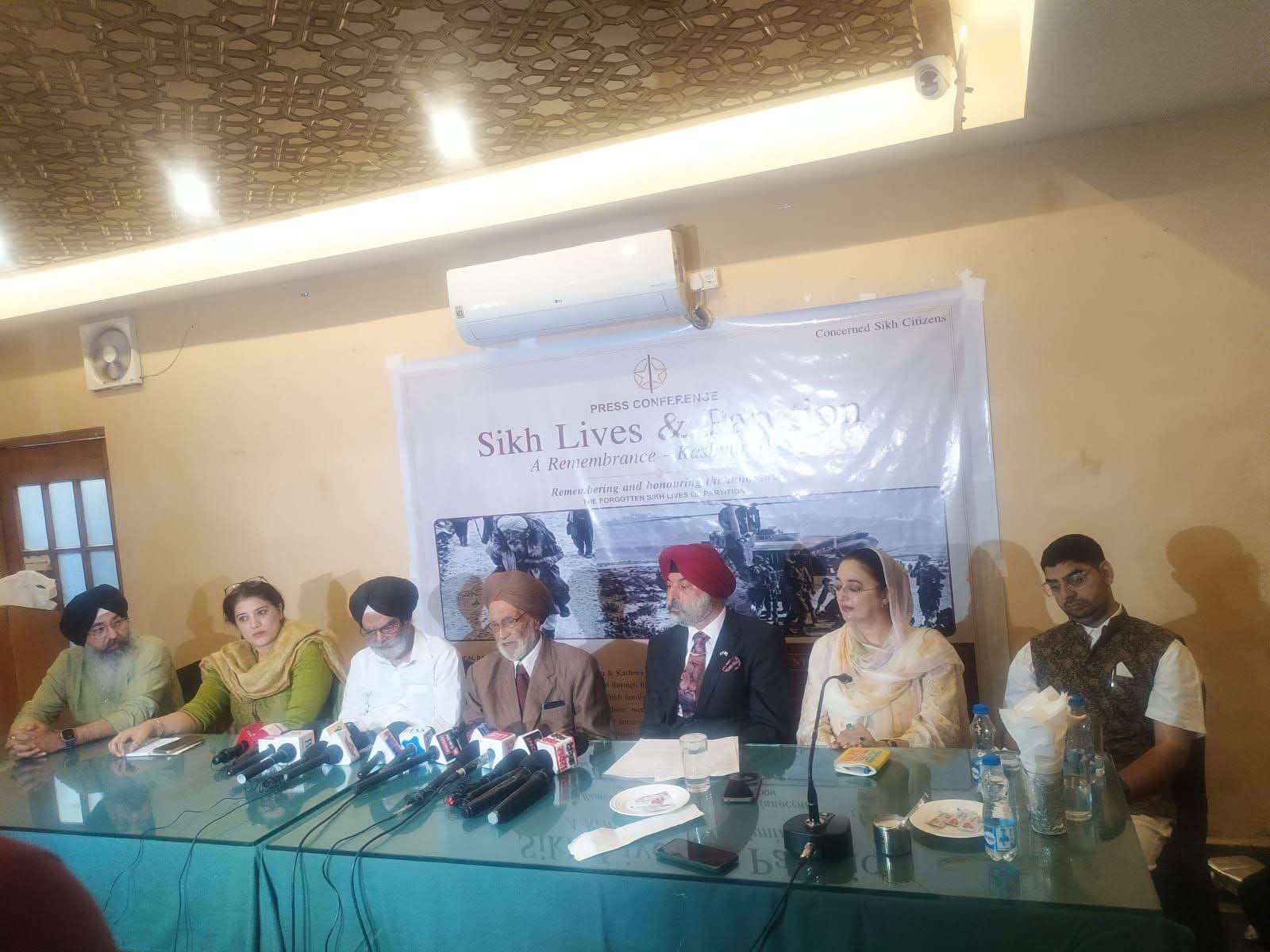


SRINAGAR, SEPT 16: A group of concerned members of the Sikh community on Wednesday urged the Jammu and Kashmir Administration to establish a dedicated memorial in Kashmir to commemorate members of the community who lost their lives during the tribal invasion of October 1947.
The demand was raised at a press conference in Srinagar, where participants also expressed gratitude to Lieutenant Governor Manoj Sinha for considering the community’s request for a memorial honouring those who made sacrifices during the turbulent events of 1947.
The programme began with a two-minute silence in memory of all those who lost their lives during the violence and upheaval that accompanied the tribal raid.
The participants recalled the sacrifices of Sikh families from villages across Baramulla, Budgam, Kamraz and Karnah, saying that many residents were killed while resisting the advancing tribal raiders after the first line of defence had been breached.
They said the local population, including Sikhs and members of other communities, formed an important second line of resistance in several areas and played a role in slowing the advance of the raiders towards Srinagar.
According to the participants, the Sikh community suffered extensive loss of life, property and displacement during the violence, with women and children among those affected.
A poster portraying the sequence of events associated with the 1947 raid was unveiled by Kirat Singh, DIG (Retd.), and Amir Suhail Wani during the programme.
The participants said the initiative was aimed at preserving the historical memory of the events and documenting the experiences of survivors and their families.
Speaking on the occasion, Commodore DS Sodhi (Retd.) thanked the Administration for considering the demand and recalled the role of Kashmiris, particularly members of the Sikh community, during the invasion.
Sodhi said members of different communities had stood together during a period of violence and devastation, describing their actions as part of Kashmir’s shared history and the spirit of Kashmiriyat.
He highlighted the losses suffered by Sikh families and said the community had yet to see a dedicated memorial in Kashmir commemorating those killed during the 1947 raid.
Sodhi also recalled instances in which members of the Muslim community helped arrange dignified funerals for victims and assisted Sikh families and individuals in escaping the advancing raiders despite the risks involved.
He said such acts of humanity were equally important to remember while documenting the history of the period.
Kirat Singh, DIG (Retd.), who retains personal memories of the period, recalled the violence, looting and arson witnessed during those traumatic days.
He expressed concern that the sacrifices and suffering of many victims had not received adequate recognition over the decades.
Dr Komal JB Singh, an academic scholar and researcher who has documented survivor narratives, stressed the importance of preserving first-hand accounts before they are lost with the passage of time.
She supported the establishment of a memorial, saying it could provide future generations with an opportunity to understand the human experiences behind the historical events of 1947.
Dr Jagmeet Kaur Bali, Chairperson of the All Sikh Minority Employees Association J&K, said the sacrifices of the Sikh minority during the tragic events of October 1947 deserved to be remembered with dignity and given an appropriate place in Kashmir’s historical narrative.
She said the proposed memorial should not be viewed as an initiative concerning one community alone, but as an effort to preserve the collective memory of Kashmir and acknowledge the suffering and courage of people who lived through the turmoil.
Author Ajit Singh Mastana highlighted the resistance offered by Sikhs in the villages of Ichama and Atina in present-day Budgam district during the events of 1947.
At the conclusion of the press conference, the participants urged the Administration to identify an appropriate and historically significant site for the proposed memorial and sought time-bound action within a defined framework.
They said the memorial should go beyond commemorating the suffering of a single community and instead reflect the broader history of Kashmir’s shared suffering, resistance, courage and acts of humanity during the turbulent period.
The participants said such a memorial could serve as a place of remembrance while helping younger generations understand the human cost of violence and the importance of communal solidarity.
Members of the Sikh community from Srinagar city and various towns and villages of Budgam and Baramulla participated in the press conference.


