
Mumbai/New Delhi, Sep 13: Union Home Minister Amit Shah on Sunday linked Prime Minister NarendraModi government’s efforts to promote Hindi and revive India’s traditional knowledge systems with a broader push to “decolonise” the country’s understanding of its history, languages and cultural inheritance.
Addressing the inauguration of the ‘Ganesh Gyanarthi Exhibition’ organised by the Asiatic Society of Mumbai, Shah said India’s historical and intellectual legacy must be presented from an “Indian perspective”, while urging institutions to make traditional knowledge accessible to students, researchers and scholars across the country.
His remarks came a day before he is due to address the inaugural session of Hindi Diwas 2026 and the sixth All India Official Language Conference in Mumbai, where the government will discuss the expansion of Hindi as the Union’s official and link language and its relationship with other Indian languages.
The back-to-back programmes underline the government’s continuing emphasis on language, cultural heritage and the recovery of what it describes as India’s indigenous knowledge traditions.
Speaking at the Asiatic Society, Shah said he had attended the event not as Home Minister but as a participant in a movement to carry forward India’s knowledge tradition accumulated over thousands of years.
He said the Asiatic Society, with government support, should emerge as a major repository and disseminator of Indian knowledge.
“A nation which cannot protect its smriti, history, values, language, records and traditions” risks decline, Shah said, arguing that even prolonged foreign rule cannot permanently enslave a civilisation that preserves its memory, values and knowledge.
He said attempts had been made to erase India’s knowledge traditions but had failed, drawing a distinction between the destruction of physical repositories and the loss of knowledge embedded in society through Shruti and Smriti.
Shah also framed India’s historical experience as one in which defeat did not prevent the country from preserving its traditions, while victory did not necessarily entail destroying the memories of those who were conquered.
“True knowledge is never held hostage by any ideology,” he said, arguing that knowledge should remain free and uninhibited.
He said the debate over who founded the Asiatic Society and why should not overshadow the question of how its present collections could contribute to building what he called a “great India”.
A central political theme of Shah’s address was his defence of the government’s concept of decolonisation.
Rejecting claims that the process amounted to rewriting or erasing history, Shah said decolonisation meant presenting history “in a complete, authentic manner and from an Indian perspective”.
He said the British had intertwined knowledge with political power and that India’s task was now to separate the two so that political and national power could instead be built on knowledge.
“It is often said in the country that history is being erased,” Shah said, adding that he did not agree with scholars who made that argument.
According to Shah, India’s knowledge had for long been interpreted through a colonial lens that sought to create a “collective inferiority complex” and weaken popular self-confidence, thereby reducing resistance to prolonged foreign rule.
He said more than eight decades after independence, both the government and the leadership of institutions such as the Asiatic Society had changed, creating an opportunity to use their collections for the welfare of India and the wider world.
He cited manuscripts and illustrations held by the society, including depictions from the Mahabharata, the Jain Kalpasutra and rare Buddhist texts, saying such material should have been brought before the public much earlier.
Shah also called for the compilation of the works of Bharat Ratna Pandurang Vaman Kane into Kane Samagra, with the material prepared for future generations.
Push for national manuscript repository
Shah asked Maharashtra Chief Minister Devendra Fadnavis to empower the Asiatic Society and urged the institution to link its manuscripts with the Centre’s GyanBharatam National Manuscript Mission.
He proposed that the society explore a campaign to collect ancestral documents from villages and scholars’ homes across Maharashtra and connect them with the GyanBharatam Manuscript Survey.
Research facilities should also be developed for manuscripts held by the society, he said, arguing that they contained knowledge capable of contributing to India’s future.
He recalled that at an informal meeting of the Gyan Bharatam Manuscript Mission, a Jain monk had argued that the foundations for making India a global leader economically and militarily lay in its ancient manuscripts.
Shah said institutions holding knowledge collections in villages, towns and states across the country should eventually be linked with the Asiatic Society to create a shared repository accessible to students, researchers and scholars.
He said the Modi government was providing the society with “every possible support and cooperation” and would continue to do so.
Hindi conference adds language dimension
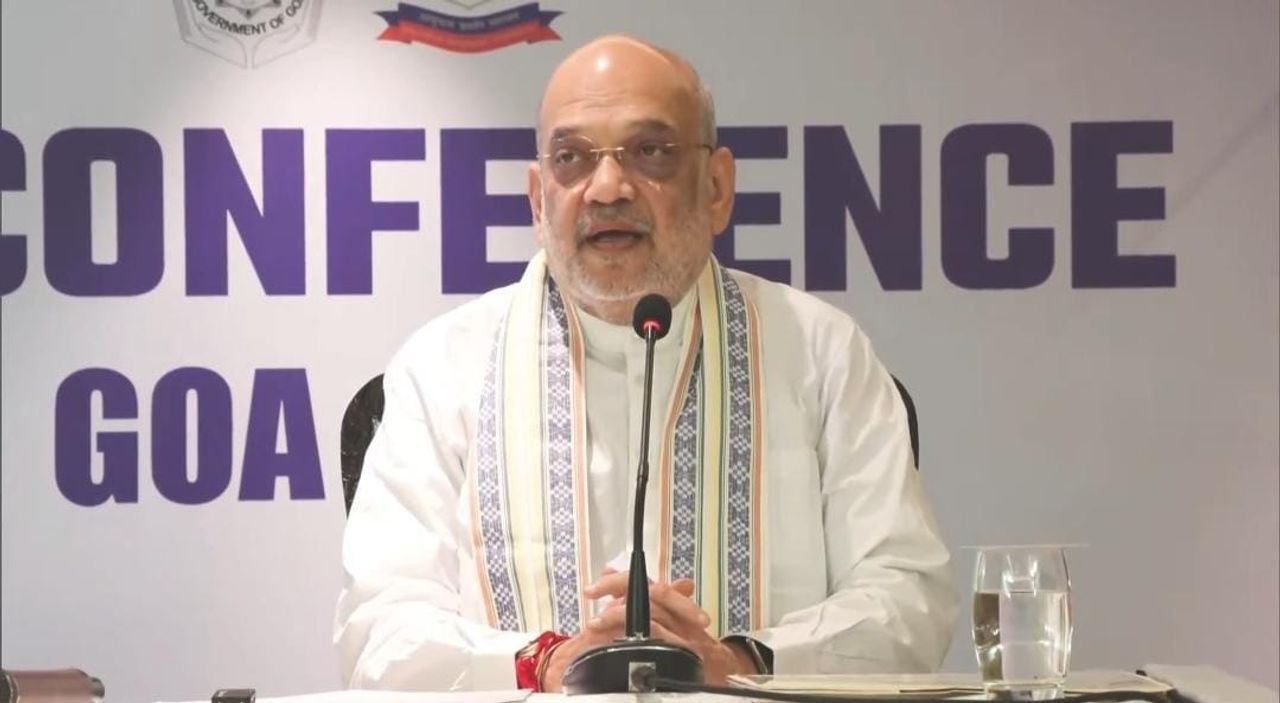
The cultural and historical push will continue on Monday when Shah inaugurates Hindi Diwas 2026 and addresses the sixth All India Official Language Conference in Mumbai.
The event will be attended by Fadnavis, Maharashtra’s two Deputy Chief Ministers, MPs, scholars, litterateurs, educationists and senior Central government officials.
The conference, organised by the Department of Official Language under the Home Ministry, has been held annually since 2021 under the Modi government. It began in Varanasi and has subsequently travelled to Surat, Pune, New Delhi and Gandhinagar before reaching Maharashtra this year.
Shah will present the Rajbhasha Gaurav and Rajbhasha Kirti awards for 2025-26 to individuals and institutions recognised for outstanding contributions to official-language work.
The conference will deliberate on Hindi as the official, people’s and link language, its coordination with other Indian languages, technology and language, translation, literature and the wider dissemination of Hindi.
A special discussion will focus on Vande Mataram, examining its historical, literary and cultural significance and its role in India’s national consciousness.
Playback singer Hariharan, journalist and writer Nilesh Mishra and researcher Akhilesh Mishra are scheduled to participate, while researcher Milind Prabhakar Sabnis will discuss the song’s historical and cultural dimensions. Joydeep Chattopadhyay, a fifth-generation descendant of Bankim Chandra Chattopadhyay, who wrote Vande Mataram, will also attend.
The conference will also discuss the role of Town Official Language Implementation Committees, or NARAKAS, which the government describes as grassroots mechanisms for implementing Hindi.
On September 15, lyricist and writer Manoj Muntashir will participate in a session before a cultural programme organised by the Maharashtra government.
A 32-stall exhibition will showcase initiatives and publications of ministries, institutions, banks and organisations working on Hindi and Indian languages.
Among the publications to be launched are a special issue of RajbhashaBharaticentred on VandeMataram, BharatiyaGyanTantra: SrotaurSwaroop, Shiv AnadiHain, AnantHain and Andheron Se UjalonTak, a compilation of writings by prison inmates.
The government has grounded its official-language policy in Articles 343 and 351 of the Constitution. Article 343 provides for Hindi in Devanagari script as the official language of the Union, while Article 351 calls on the Union to promote, develop and enrich Hindi.
The government says the conference is intended to strengthen coordination and partnership among Hindi and other Indian languages.
Taken together, Shah’s remarks at the Asiatic Society and the government’s Hindi conference point to a wider political project: recasting language, historical memory and traditional knowledge as instruments of national confidence while seeking to move away from what the government regards as colonial interpretations of India’s past.