
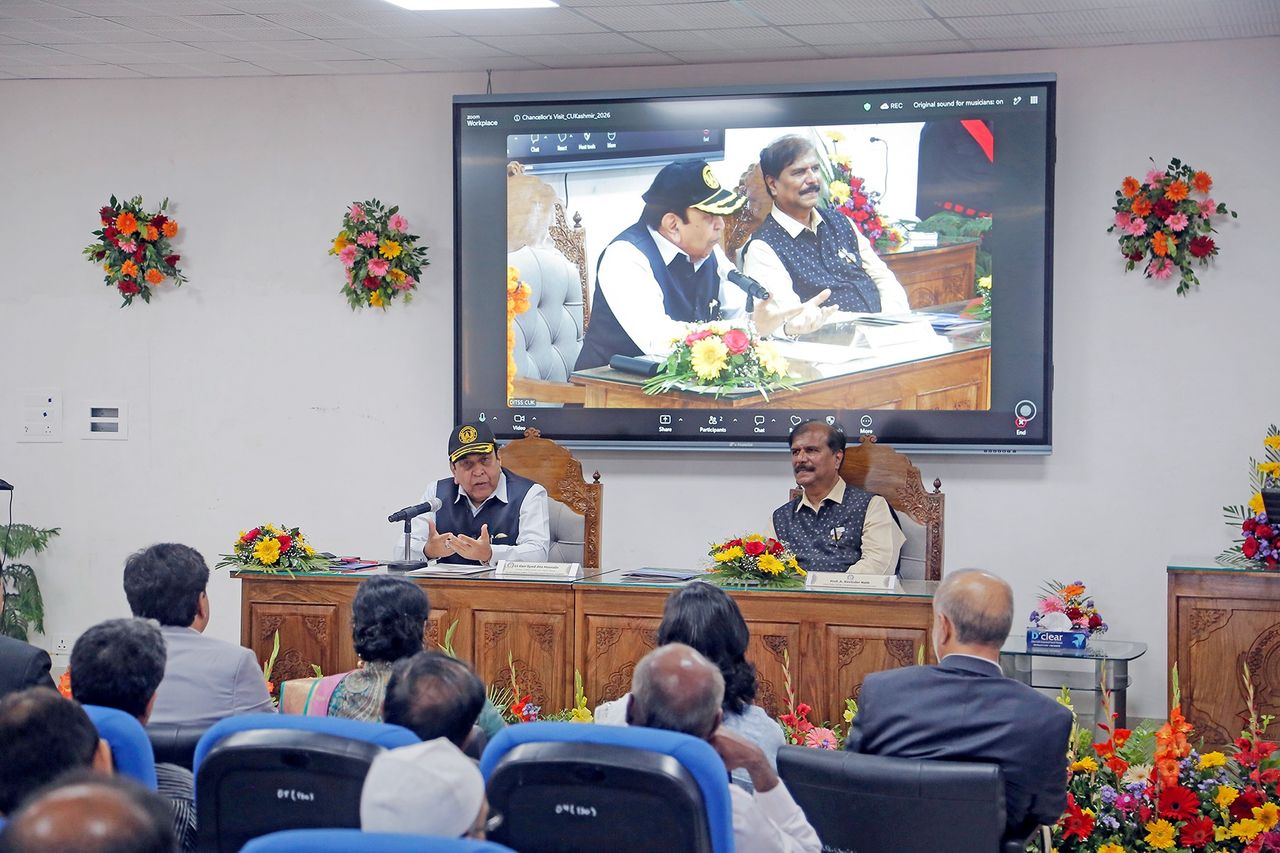

Central University of Kashmir (CU Kashmir) on Monday started its LEAD Lecture Series with the first Luminary Lecture on “Geopolitics and International Relations”, delivered by Lt General (Retd) Syed Ata Hasnain, Hon’ble Governor of Bihar and Chancellor, CU Kashmir, at the Tulmulla Campus.
Addressing the gathering, Lt Gen Hasnain lauded the University’s achievements and appreciated its lecture initiatives, stating that the University’s presence had added vibrancy to Ganderbal and was contributing to its economic development.
Reflecting on Ganderbal’s strategic significance, Lt Gen Hasnain observed that the district occupies an important position in Jammu and Kashmir, particularly as a vital axis towards Ladakh. He noted that the Srinagar-Leh axis had played a crucial role during the Kargil conflict and remained strategically important, with the Zojila Tunnel further strengthening connectivity. He said the expansion of businesses, showrooms and cafeterias indicated economic progress.
Emphasising the transformative power of knowledge, Lt Gen Hasnain said CU Kashmir’s contribution to society extended far beyond conventional teaching and learning. Deliberating upon Bihar’s intellectual heritage, he said knowledge had historically travelled from ancient centres such as Pataliputra and Nalanda across India and beyond, and that CU Kashmir was bringing knowledge and new possibilities to Ganderbal. He called upon students to develop into “scholar warriors” by cultivating multidisciplinary knowledge and intellectual curiosity. “In today’s world, knowledge is everything,” he said, stressing that students should acquire familiarity with political science, history, geography and economics alongside their core disciplines.
Lt Gen Hasnain highlighted the importance of dialogue, debate and accepting differing viewpoints. He said the younger generation was questioning established ideas and educators should encourage students to examine assumptions, seek evidence and recognise when they were wrong. The ability to discuss differences and arrive at a compromise, he maintained, was essential for managing conflict and building a harmonious society.
Dwelling on Jammu and Kashmir’s changing environment, he said the return of peace had created an opportunity for youth to reclaim lost time and realise their potential. He urged students to develop skills, nurture positive ideas and use available opportunities. Lt Gen Hasnain called for greater academic focus on disaster management, particularly in disaster-prone Jammu and Kashmir. Referring to earthquakes, floods, climate-related hazards, glacier-related risks and debris flows in the context of the recent tragedy in Nepal, he said universities had an important role in awareness, research and preparing communities to respond effectively. He suggested that disaster management should be pursued regularly as an academic and research area.
On India’s global position, Lt Gen Hasnain said the country was making significant economic progress and enhancing its standing internationally. He emphasised geo-economics alongside geopolitics and said India’s diversity and ability to function cohesively constituted a major strength. He also underscored academic exchange, welcoming students from different parts of India to CU Kashmir and encouraging students from Kashmir to pursue learning opportunities elsewhere.
Welcoming the gathering, Vice-Chancellor Prof. A. Ravinder Nath said the University was privileged to host Lt Gen Hasnain and described his presence as a source of motivation and inspiration. He said CU Kashmir was expanding its academic and infrastructural footprint and was committed to creating a campus that would emerge among the best in the country. He informed that CU Kashmir currently has 21 departments and nine schools, with four additional departments and two more schools proposed for the next academic year. He said the University had introduced more than seven new programmes during the last three years across general, professional, technical, vocational and emerging domains.
Prof. A. Ravinder Nath highlighted CU Kashmir’s growing diversity, noting that students from several States constituted nearly 20 percent of enrolment, while faculty members represented many States. He said the University was redesigning curricula in line with NEP 2020, incorporating the Indian Knowledge System, design thinking, innovation and Sustainable Development Goals. He also announced plans for specialised centres, including a Centre for Geopolitics and International Relations, public policy and economics, and comparative religion and social sciences.
In her speech, Dean International Affairs and member of the LEAD Lecture Series committee, Prof. Sandhya Tiwari, presented the framework of the initiative. She said the LEAD Lecture Series was designed to develop life-coping skills, professionalism and ethical practices, inspire innovation, promote knowledge creation and contribute to a strong nation. Aligned with UGC benchmarks, NAAC criteria and NEP 2020, the framework comprises Luminary, Expert and Distinguished Lecture Series.
The Luminary component will feature transformational lectures by leaders and visionaries; the Expert series will connect students with subject experts, industry leaders and researchers; while the Distinguished series will focus on advanced discussions on research, policy and global trends.
Dean Academic Affairs and Organising Committee Chairman Prof. Shahid Rasool, Registrar Dr. Nisar Ahmad Mir, Deans of Schools, Heads and Coordinators of Departments, senior administrative functionaries, faculty members, research scholars and students were present.