


 NEW DELHI, OCT 24: India has achieved a significant milestone in strengthening its indigenous underwater warfare capabilities with the inauguration of the Setting to Work Phase-2 (STW-2) activity of the Air Independent Propulsion (AIP) system Energy Module developed by the Defence Research and Development Organisation (DRDO) for the Indian Navy’s diesel-electric submarines.
The development marks an important step towards enhancing the underwater endurance of conventional submarines by reducing their dependence on atmospheric oxygen, a key operational limitation of diesel-electric propulsion systems.
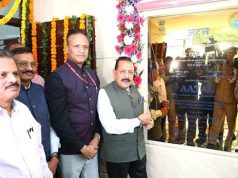
The inauguration ceremony was held today at Larsen and Toubro’s A.M. Naik Heavy Engineering Complex in Hazira, Gujarat. Defence Secretary, Secretary of the Department of Defence Research and Development, and DRDO Chairman Rajesh Kumar Singh attended the ceremony virtually as the chief guest. Vice Admiral B. Sivakumar, Chief of Materials of the Indian Navy, and Dr. R. Balamuralikrishnan, Director General (Naval Systems and Materials), DRDO, attended the event at the Hazira facility.
The indigenous AIP Energy Module has been developed by DRDO’s Naval Materials Research Laboratory (NMRL) in collaboration with industry partners. The technology is intended to improve the operational endurance of diesel-electric submarines while submerged, strengthening their ability to remain underwater for extended periods without frequently surfacing or using a snorkel to obtain atmospheric oxygen.
Addressing the event, DRDO Chairman Rajesh Kumar Singh congratulated the DRDO scientists and industry partners, acknowledging their scientific perseverance and industrial collaboration in advancing the indigenous AIP programme from development towards practical implementation.
He also appreciated the Indian Navy’s continued cooperation throughout the programme, particularly its role in testing and validating the system at successive stages of trials.
Emphasising the importance of the next stages, Singh called for continued efforts to meet the Navy’s planned induction timelines while maintaining stringent safety standards. He specifically highlighted the need for uncompromising safety practices in handling hydrogen and fuel-cell technologies associated with the system.
The programme will now advance to the next phase, during which the AIP Energy Module will be energised to generate power and undergo rigorous testing in accordance with Indian Navy protocols.
Following successful completion of the prescribed tests, the module is scheduled to be handed over to Mazagon Dock Shipbuilders Limited (MDL) for integration with a Kalvari-class submarine in early 2027.
Air Independent Propulsion is an important technology for conventional submarines because it allows them to generate power underwater without relying entirely on atmospheric oxygen. Diesel-electric submarines traditionally need to surface or operate near the surface using a snorkel to run their diesel engines and recharge their batteries.
An effective AIP system can reduce the frequency of such operations, enabling submarines to remain submerged for longer periods and potentially improving their operational flexibility and survivability.
The latest milestone also highlights the importance of collaboration between DRDO, the Indian Navy and domestic industrial partners in developing complex defence technologies within the country.
With the system moving towards power-generation trials and eventual submarine integration, the programme represents a significant step in India’s efforts to strengthen indigenous naval capabilities and reduce dependence on foreign technologies in strategically important underwater propulsion systems.
The planned integration on a Kalvari-class submarine in early 2027 will mark the next major stage of the programme, subject to successful testing and completion of the prescribed technical and safety requirements.