Srinagar, Sep 27: Business organisations across Jammu and Kashmir have renewed their demand for a comprehensive Special One-Time Settlement (OTS) scheme, arguing that legacy debt accumulated over decades cannot be resolved through repeated SARFAESI notices, auctions, litigation, and dispossession alone.
The demand has gained urgency amid continuing recovery proceedings by Jammu and Kashmir Bank, including SARFAESI notices, possession proceedings, and e-auction notices, even as a Special OTS is understood to be under consideration.
Industry representatives maintain that much of the existing financial stress did not arise from wilful default but from prolonged turmoil, shutdowns, natural calamities, the 2014 floods, successive disruptions, and uncertainty following the reorganisation of J&K.
They point out that while businesses were unable to function normally during several of these periods, interest, wages, statutory liabilities, and other operating costs continued to accumulate, eventually pushing a significant number of enterprises into financial distress.
The business chambers are now seeking a Special OTS broadly modelled on the State Bank of India’s OTS-2020, suitably adapted to the financial position of J&K Bank and the circumstances of borrowers in the region.
SBI OTS-2020 covered eligible NPA and AUCA accounts in manufacturing, trade, services, and agriculture with outstanding balances above Rs 20 lakh and up to Rs 50 crore.
Accounts pending before courts and Debt Recovery Tribunals, as well as those facing SARFAESI proceedings, were also eligible.
The scheme provided a formula-based waiver of 20 percent of the secured portion for Doubtful-I accounts and 25 percent for Doubtful-II, Doubtful-III, loss, and AUCA accounts.
Waivers on the unsecured portion were substantially higher, while notional interest from the date of NPA and legal expenses were also waived.
Settlement could be completed without interest within six months, or within eight months with interest at the six-month MCLR on a reducing-balance basis.
Early payments also attracted additional incentives ranging from 5 to 15 percent.
The business organisations argue that the broad architecture of such a scheme could be adopted by J&K Bank, with appropriate regional modifications, while maintaining the Bank’s recovery interests.
They have also pointed to the Reserve Bank of India’s 2023 Framework for Compromise Settlements and Technical Write-offs, which expressly recognises compromise settlements as a mechanism for resolution of stressed assets.
The RBI framework requires banks to have Board-approved policies covering eligibility, permissible sacrifice, security valuation, approval hierarchy, monitoring, and cooling periods.
J&K Bank has reportedly introduced a general OTS policy this year in line with the regulatory framework.
Business representatives, however, contend that stringent conditions, case-specific discretion and the absence of a sufficiently liberal and uniform formula have resulted in very few meaningful settlements.
According to them, the RBI framework does not prevent a bank from introducing a special, uniform or category-wise OTS, provided it is approved by the competent authority and complies with applicable regulations.
They therefore argue that the J&K Bank Board has adequate institutional space to consider a special scheme broadly replicating the tested architecture of SBI OTS-2020.
The issue has become particularly contentious over the question of linking the Special OTS to the forthcoming Industrial Policy.
During meetings with two major business organisations this month, J&K Bank management reportedly indicated that the Special OTS could be introduced alongside the new Industrial Policy.
The matter is also understood to have figured in a recent policy review chaired by Chief Minister Omar Abdullah.
Business representatives, however, question why settlement of bank debt should have to wait for the Industrial Policy, which may require further consultation, finalisation, and approvals.
They argue that an OTS falls within the bank’s institutional framework and can be considered independently, allowing borrowers to mobilise resources, arrange financing, or sell assets to meet settlement obligations.
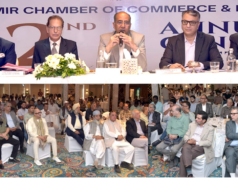
Advisor to Chief Minister Nasir AslamWani, while speaking at the 92nd Annual General Meeting of the Kashmir Chamber of Commerce and Industry, said that any such settlement mechanism should be without an upper limit, indicating that the issue could be considered from a broader perspective to ensure that eligible cases are covered.
The organisations have sought one major modification to the SBI model — a substantially longer repayment period.
They propose retaining the broad formula while extending the liquidation period to up to two years, with interest at the applicable MCLR after the initial interest-free period.
The argument is that a longer repayment window would make settlement achievable for borrowers facing severe liquidity constraints while continuing to protect the bank’s recovery interests.
The organisations have acknowledged that J&K Bank must maximise recovery and protect public money.
At the same time, they argue that the bank should take into account the interest already paid by local enterprises over decades, as well as the collateral and personal guarantees provided by borrowers when businesses had limited banking alternatives.
They have also raised concerns over the reputational consequences of repeated newspaper notices, possession proceedings and auctions, particularly in Kashmir’s closely connected business and social environment.
For entrepreneurs whose businesses failed because of circumstances beyond their control, they argue, public notices and the auction of family or ancestral properties should not become the only mechanism for recovering legacy dues.
Another concern relates to the possible sale of stressed accounts to Asset Reconstruction Companies outside J&K.
Business representatives contend that if recovery through e-auctions fails to generate meaningful returns, transferring local stressed accounts and mortgaged properties to outside entities could have wider economic implications.
They have questioned whether such entities would adequately understand the circumstances that contributed to defaults or the wider implications of aggressive enforcement in the region.
The organisations have also referred to past ARC transactions which, according to records cited by them, generated only a small fraction of the outstanding amounts, with some transactions allegedly involving very high haircuts.
They have called for public disclosure of the outstanding amount, security value, sale consideration, and sacrifice involved in any such transaction.
Their argument is that if an ARC can acquire a stressed account at a steep discount, the original borrower should first be given an opportunity to settle the account on terms that could potentially provide a better recovery for the bank.
The immediate demands include temporary suspension of coercive recovery action against genuinely eligible borrowers, announcement of a transparent Special OTS without waiting for the Industrial Policy and provision of a fair settlement opportunity to eligible borrowers before further coercive measures are taken.
The J&K government, as the majority shareholder in J&K Bank, has also been urged to sensitise the bank’s Board about the exceptional circumstances endured by businesses in the region.
The objective, industry representatives say, should be to ensure that potentially viable enterprises are not liquidated before proposed revival measures have an opportunity to take effect.
They have also urged the central government and RBI to view the demand as an effort to unlock recovery rather than evade legitimate debt.
A properly structured OTS, they argue, could bring funds currently locked in NPAs, litigation and prolonged enforcement back into the banking system, while allowing viable enterprises to rebuild and genuinely unviable borrowers to exit through a structured settlement.
The issue, therefore, is not whether bank debt should be recovered.
Business organisations acknowledge that legitimate dues must be recovered.
Their contention is that the method of recovery assumes particular importance in the case of legacy accounts arising from prolonged economic and social disruption.
They argue that a transparent, formula-based settlement could provide the bank with a predictable recovery mechanism while giving borrowers a realistic opportunity to close long-pending liabilities.
The central question now being raised is whether decades-old debt should continue to be pursued through prolonged litigation, distress auctions and enforcement proceedings, or whether a structured settlement can convert a significant portion of that legacy debt into actual recovery while preserving viable businesses and productive assets.
The demand is consequently for the Special OTS to be considered as an immediate and independent intervention rather than being held back until the new Industrial Policy is finalised.