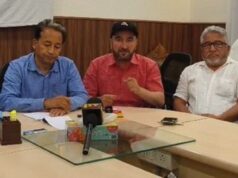



Leh, Sep 10: Ladakh Chief Secretary Ashish Kundra on Thursday said the Centre and representatives of Ladakh are moving towards a framework for constitutional safeguards for the region under a special provision in Article 371 and the formation of a Union Territory-level elected body vested with legislative, executive and financial powers.
Kundra made the announcement after a sub-committee meeting with representatives of the Leh Apex Body and the Kargil Democratic Alliance (KDA), where discussions focused on taking forward progress made in earlier rounds of dialogue.
Explaining the proposed political architecture, Kundra said the panchayat would remain the foundational unit, followed by the Ladakh Autonomous Hill Development Councils (LAHDCs), with the proposed UT-level body above them.
Speaking to reporters here, the chief secretary noted that the Centre was not seeking to impose any political model on Ladakh and wanted to proceed only after consulting and deliberating with stakeholders and people of the Union Territory.
“It was discussed that for providing constitutional safeguards for Ladakh, a special provision under Article 371 would be made, which could provide safeguards for the people here. And what would the safeguards be? The basis of the democratic movement that has started here is that safeguards should be provided for the land of the people of Ladakh, their culture, their environment and their natural resources, all these things”, Kundra said.
“Now the process of discussion and negotiations is continuing. The next meeting is scheduled for October, and we hope that by the next meeting an advanced draft of the Constitutional Amendment Bill will be ready,” he added.
The representatives were also briefed on the parliamentary process involved in the constitutional amendment and the legislation required for details regarding the proposed body’s powers.
“So, from the UT administration and the Ministry of Home Affairs, we are making every effort so that the aspirations of the people, their democratic aspirations, can be fulfilled”, he added.
Briefing reporters on the ongoing political dialogue, Kundra said the previous meeting on July 3 had decided to take the process forward on the understanding that such a body would be constituted.
“There was a discussion about whether there should be direct elections from constituencies to this body or indirect elections through the Ladakh Autonomous Hill Development Councils (LAHDC). All those who attended from the Apex Body and the KDA were of the view that there should be direct elections from constituencies, and there was agreement on this issue,” he said.
Kundra said the dialogue was aimed at addressing the aspirations of the people of Ladakh, particularly their demand for protection of land, culture, heritage, mineral resources, environment and jobs.
“As far as jobs are concerned, a reservation process has already been provided. This is a unique reservation system for Ladakh, and there is no similar reservation system anywhere else in the country,” he said.
For the remaining issues, the Centre has conveyed that constitutional protection would be provided, he said.
“There are therefore some questions regarding the relationship between the LAHDC and the UT-level body—what powers would fall within the jurisdiction of the LAHDC and what powers would fall within the jurisdiction of the UT-level body,” he said.
A list of eight to ten such questions was shared with the leaders at the meeting, who were asked to deliberate on them, consult among themselves and with the people before conveying their views to the government, Kundra added.
He stressed that the exercise involved a Constitutional Amendment and not an ordinary law and, therefore, required the requisite parliamentary majority and political consensus.
“A constitutional amendment requires a majority. Therefore, there has to be political consensus across political parties, including among the Members of Parliament who will be involved in the process,” he said.
Kundra said the process would essentially have two stages, with major provisions incorporated through the constitutional amendment, followed by detailed legislation and regulations for Ladakh.
He said the proposed amendment would have to undergo the full parliamentary process.
He said legal drafting of the constitutional amendment bill would follow only after consensus was reached on the underlying principles.
“The central government does not want to impose any model that is not acceptable to the people. The intention is to move forward only after consultation and deliberation among everyone,” he said.
Urging patience in the process, the chief secretary said haste could result in an arrangement that might subsequently prove difficult to change.