

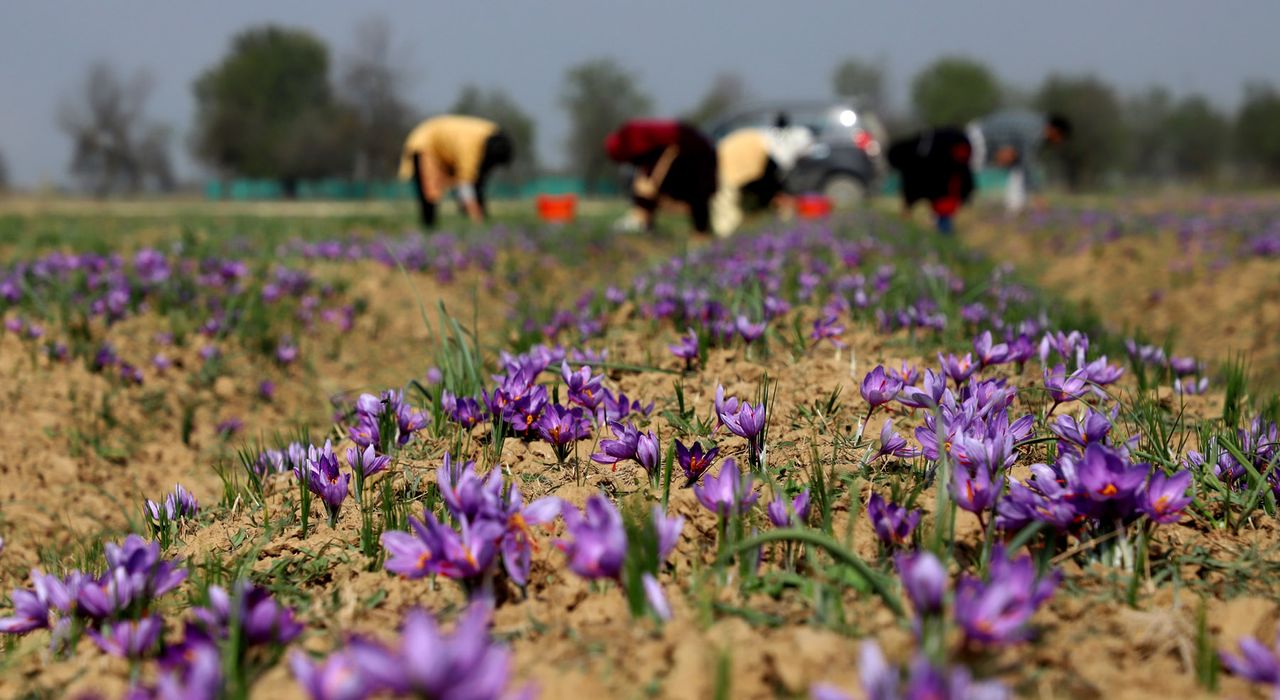


Srinagar, Sep 9: Jammu and Kashmir could begin testing whether its agricultural land can produce both crops and electricity, with a small proposed saffron agrivoltaics project at Pampore offering a possible starting point for combining farming with solar power.
Agrivoltaics, also known as Agri-PV, involves installing solar panels above or between crops so that the same piece of land can continue to be cultivated while also generating electricity.
The approach is gaining attention in India as policymakers look for ways to expand renewable energy without taking productive agricultural land out of farming.
For Jammu and Kashmir, the idea could be particularly relevant because land is under pressure from agriculture, horticulture, settlements, infrastructure and other competing uses.
Instead of permanently converting farmland into conventional solar parks, agrivoltaics offers a model in which agricultural production could continue alongside power generation.
A small experiment proposed at the Advanced Research Station for Saffron and Seed Spices (ARSSSS), SKUAST-K, Pampore, seeks to examine whether the concept can work in Kashmir’s saffron-growing areas.
A Detailed Project Report titled “Detailed Project Report for Saffron-Based Agrivoltaics System” has been prepared for a research project involving ARSSSS, SKUAST-K, NIT Srinagar and JK Green Technologies.
The proposal envisages an approximately 16.74-kilowatt pilot installation in saffron fields.
The experiment proposes testing three different solar-panel arrangements, each involving around 5 kW of capacity.
One would use vertically installed bifacial panels oriented towards the east, another would use vertical bifacial panels facing west, while the third would use conventional panels tilted 30 degrees towards the south.
The comparison is intended to establish how different panel designs affect both electricity generation and saffron cultivation.
According to the project proposal, the south-facing panels could generate around 8.1 megawatt-hours of electricity annually, substantially higher than the approximately 3.2 MWh expected from each of the east- and west-facing vertical arrangements.
However, the project is not designed simply to identify which panel produces the most electricity.
Its larger purpose is to determine which arrangement offers the best combined outcome for agriculture and power generation.
A vertical panel system could produce less electricity but may take up less agricultural space and allow greater access to sunlight, rain and snow on the soil.
It could also interfere less with regular farm operations.
A partially elevated or tilted system, meanwhile, could provide shade and potentially influence soil moisture and temperature, but could also reduce the amount of sunlight reaching the saffron crop.
The proposed research is therefore intended to provide evidence on whether saffron production and solar generation can practically coexist under Kashmir’s conditions.
The project could have wider importance because saffron cultivation in Kashmir faces challenges linked to climate variability, water availability and productivity, while valuable saffron-growing land is also under pressure from changing land use.
If farmers can generate additional income from solar electricity without significantly reducing saffron production, agrivoltaics could potentially strengthen the economic case for retaining agricultural land under saffron cultivation.
The DPR makes a much larger theoretical calculation by considering around 3200 hectares of saffron land and assuming a solar potential of 0.5 MW per hectare.
On that basis, it estimates a theoretical potential of around 1600 MW.
However, the figure remains a projection rather than an established resource potential.
The proposed 16.74-kW pilot cannot by itself demonstrate that 1600 MW of solar capacity can be installed across saffron fields while maintaining commercially viable cultivation. The assumed 0.5 MW per hectare density would also need to be tested under actual Kashmiri conditions.
The proposed pilot is estimated to cost around Rs 10.42 lakh, making it a relatively small investment for generating evidence that could guide much larger agricultural and renewable-energy programmes.
Researchers could strengthen the experiment by comparing the solar plots with a nearby saffron plot without panels.
Such a control plot would allow researchers to assess whether changes in crop performance are actually linked to the solar installation.
The study could also examine results over several crop cycles and record flower production, stigma yield and quality, corm health and multiplication, soil moisture and temperature, irrigation requirements, disease incidence, snowfall behaviour and changes in the local microclimate.
From an economic perspective, the most important measure would be the total income generated from the same piece of land — income from saffron combined with revenue from electricity, after accounting for additional investment, maintenance and agricultural costs.
The proposed research comes as the Centre is also exploring a wider role for agrivoltaics. ICAR-IARI has established a 100-kWp Agri-PV research facility in New Delhi with MNRE, NISE and GIZ to study different crop and solar configurations.
The union government is also preparing PM-KUSUM 2.0 with a proposed dedicated 10-GW Agri-PV component.
The policy direction could provide an opportunity for J&K to develop its own crop-specific research before larger schemes are rolled out.
Experts involved in such work would need to consider that different crops require different designs.
Panel height, spacing, orientation and density suitable for saffron may not be appropriate for apple orchards, vegetables, floriculture or medicinal and aromatic plants.
For J&K, the proposed Pampore pilot could therefore serve as a first research platform for studying how solar generation can be integrated with agriculture without compromising crop production.
The central proposition is simple: rather than choosing between agricultural land and solar power, Jammu and Kashmir could explore whether the same land can support both. The answer will depend on scientific evidence, crop performance, economics, and careful site-specific design.


