
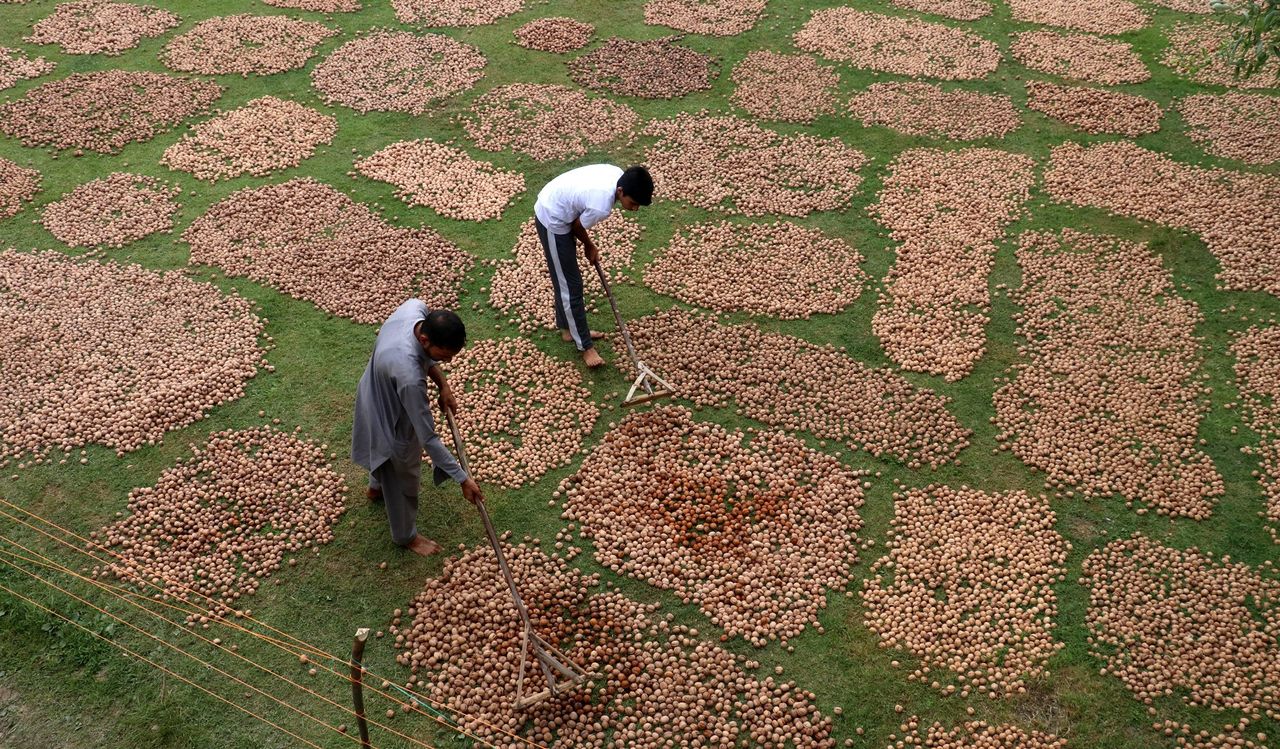


For Kashmir’s walnut workers, the harvest lasts a few weeks. A fall from a tall tree can leave them paralyzed for life.
Ashiq Hussain was 17 when he fell from a walnut tree in 2002. The fall left him paralyzed.
Now 42, Ashiq of Boniyar in Uri lives in a wheelchair with his 80-year-old mother and has no regular livelihood.
He spent about a month undergoing treatment before returning home. His father died in 2011 and his brother, who supported the family, died in 2015.
Ashiq receives Rs 1,200 a month from the Social Welfare Department. His mother gets Rs 1,500.
The 2014 floods washed away their maize field and damaged their house. His brother later built a few rooms for the family.
Ashiq is one of many Kashmiris whose lives have been permanently changed by falls from orchard trees.
Shahid Maqbool Lone, 28, of Gatipora, has lived with paralysis since a fall during the 2018 walnut harvest.
A branch loosened as he climbed, sending him to the ground. He suffered head and back injuries and underwent surgery but remained paralyzed.
Shahid had worked as a laborer during the harvest to support his family. He now lives with his parents, younger brother and younger sister. The family also struggles with stomach, kidney and lung problems.
He cannot afford a wheelchair suited to his condition. A wheelchair provided through social welfare was also unsuitable.
Shaheen, 30, of Verinag in Anantnag, was 19 when he slipped from a walnut tree during the 2015 autumn harvest.
The fall left him paralyzed.
He said the hardest part is watching his parents and brother struggle to support the family. His brother works as a shepherd. The Voluntary Medicare Society provided Shaheen with a wheelchair.
In Hirpora, Shopian, 33-year-old Muhammad Abbas has been bedridden since a fall from an apple tree caused a spinal injury in December 2023.
Married with two children, Abbas depends on his father and brothers, who themselves struggle to support the family.
Mushtaq Ahmad, an orchardist from Tral, said he knows at least a dozen people who had been paralyzed after falling from walnut trees. A neighbor, he said, also fell and remains bedridden.
Most victims were breadwinners who climbed tall trees without helmets, harnesses or other protective gear to earn seasonal income.
Seasonal laborers earn Rs 1,000 to Rs 1,500 for every eight large bags of walnuts they harvest.
Fresh cases
The danger has returned with this year’s harvest.
Walnut harvesting began about two weeks ago and is expected to continue through October. Hospitals across Kashmir are already treating workers for fractures, and for limb, pelvic, head and cervical spinal injuries sustained after falls from trees.
At Bone and Joint Hospital in Srinagar, several patients with walnut-tree fall injuries have been treated this season, including at least three with spinal injuries.
At SKIMS Bemina, orthopedic specialists have also reported spinal injuries linked to walnut-tree falls this season.
Dr. Shabir Dhar, professor of orthopedics at SKIMS Bemina, said the height of walnut trees makes such falls particularly dangerous.
Workers can hit branches on the way down before striking the ground, causing head, spinal, pelvic and limb injuries. The cervical spine is particularly vulnerable because of its mobility and relative fragility.
Spinal injuries have also been reported this season at SKIMS Soura. GMC Baramulla and GMC Handwara have reported fractures and spinal injuries among walnut harvest workers.
At GMC Anantnag, seven patients with different fractures have been treated since harvesting began.
One suffered a spinal fracture resulting in paraplegia, underwent surgery and remains admitted, said Dr. Younis Kamal, Professor of orthopedics.
Another case is 50-year-old Abdul Rehman Ganai of Khansahib, Budgam, who suffered paraplegia after falling while harvesting walnuts at Kramsherwar.
Ganai was admitted to Bone and Joint Hospital on Sep 2 and underwent surgery. He was discharged after a few days but remains bedridden.
A laborer, Ganai has four walnut trees but no orchard of his own. He works during the walnut season to supplement his family income.
His wife, six daughters and one son depend on him. His father-in-law, Abdul Rashid, worries about whether Ganai will be able to work again.
CARE Foundation JK @ Valley Wheeliez, an organization of more than 200 physically challenged persons, including people with spinal cord injuries, said government support for persons with severe disabilities remains minimal.
“All of us are wheelchair users who have confronted the physical and emotional realities of severe disability. Despite having no proper source of income, the organization continues to help people with severe disabilities and provide support to wheelchair users,” said Dildar Ahmad Shapoo, president of the organization.
He said the foundation is dedicated to the rehabilitation and empowerment of wheelchair-bound spinal cord injury persons.
A documented hazard
Medical studies from Kashmir have documented the dangers of walnut-tree falls for years.
Research from SKIMS Soura found spinal fractures in about 45% of patients admitted after walnut-tree falls. About 20% developed quadriparesis and 25% died, with severe brain injuries contributing to many deaths.
A study by Dr. Asif Nazir Baba and colleagues at Bone and Joint Hospital found falls from more than 15 meters particularly likely to cause severe injuries because of the impact on hard ground.
Common injuries included heel and wrist fractures, head and cervical spine injuries, pelvic fractures and long-bone fractures.
Spinal fractures accounted for nearly 40% of cases, with thoracolumbar injuries the most common, followed by cervical injuries.
Cervical fracture-dislocations were frequent among workers who landed head-first.
The study also recorded brachial plexus injuries when workers tried to catch branches with outstretched hands. Two such injuries were recorded in a series of 115 patients.
A 2009 Bone and Joint Hospital study recorded 37 spinal fractures among walnut-fall victims, with neurological deficits in 17%.
Another hospital series of 54 patients found that 92.6% were men, with a mean age of 48. Spinal injuries accounted for 44.4% of cases, particularly wedge-compression fractures of the lumbar spine.
A larger dataset found spinal injuries in 18.1% of walnut-tree fall cases, including thoracic injuries in 7.8%, lumbosacral injuries in 6.3% and cervical injuries in 3.9%.
Dhar said falls from height are among the leading causes of fatal and nonfatal adult injuries, alongside road crashes. In Kashmir, walnut harvesting concentrates such injuries into a few months each autumn, adding to the burden on hospitals.
“Walnut-tree falls can cause burst spinal fractures, complex long-bone injuries and brachial plexus damage. Many victims land on their heads or shoulders, exposing the cervical spine to severe trauma,” Kamal said.
Complete spinal cord injuries can cause permanent loss of movement and sensation below the affected level.
Only a small proportion of patients with complete injuries regain meaningful function, he said.
For Ashiq, the harvest ended 24 years ago.
The paralysis did not.
And this year’s harvest is only beginning.