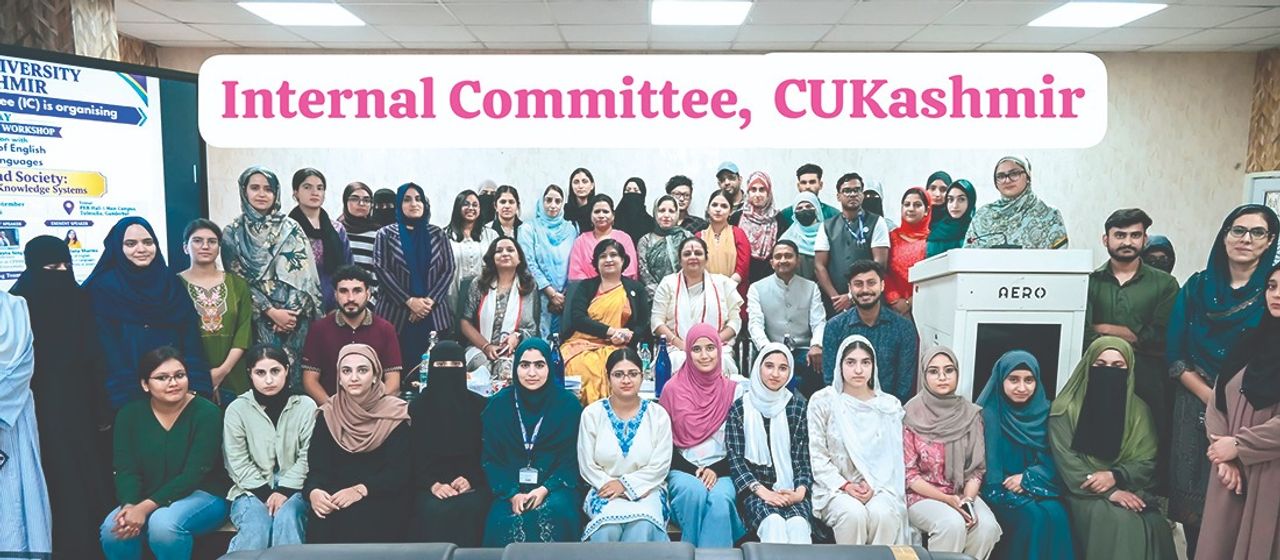

Ganderbal, Sep 18: The Internal Committee (IC), Central University of Kashmir (CUK), in collaboration with the Department of English, School of Languages, organised a one-day national-level workshop on “Women and Society: Revisiting Indian Knowledge Systems” at Tulmulla campus here on Friday.
In her opening remarks, Prof. Sandhya Tiwari, Presiding Officer, Internal Committee and Dean, School of Languages, said the Internal Committee of CU Kashmir had set forth an agenda to make use of every possible opportunity for the benefit of students, scholars, faculty and staff as per scope and viability.
In line with the aforementioned precept, this time the IC had conceived this workshop in collaboration with the Department of English to provide students and scholars an opportunity to listen to two women academicians and administrators on the chosen theme of women and society from the perspectives of IKS.
She also highlighted the importance of awareness about rights and contemporary social realities, while connecting these concerns with India’s intellectual legacy. “This is an occasion and a platform, aligned with the Bharatiya Gyan Parampara, for not only knowledge sharing but also for providing clarifications,” she observed, stressing that an open-minded engagement with knowledge is central to meaningful learning. She further noted that the workshop sought to explore how women have contributed as nation-builders and what is required for them to continue making meaningful contributions.
Prof. Sandhya Tiwari expressed her heartfelt gratitude to the Vice-Chancellor, Prof. A. Ravinder Nath, for his continued support and guidance in organising such programmes.
In her detailed presentation, Prof. Vandana Sharma, Professor of English and Dean, School of Languages, Central University of Jammu, deliberated upon the idea of women’s dignity and self-respect. Drawing upon the metaphor of a river, she explained that a meaningful life requires a larger purpose, perseverance through difficult circumstances and the ability to remain committed to one’s goal.
“For getting samman and respect in life, it is very important that we start looking at our life, wherein we have a big aim in life,” she said.
Prof. Sharma also reflected on the relationship between masculine and feminine principles in Indian knowledge traditions, describing them as complementary rather than competitive. She traced the intellectual, spiritual, literary and social contributions of women across different periods, referring to figures including Lalleshwari, Lopamudra, Gargi, Maitreyi, Akka Mahadevi, Mirabai, Razia Sultana, Savitribai Phule, Fatima Sheikh, Pandita Ramabai, Sarojini Naidu and women pioneers in science and other fields.
Emphasising the relevance of gender sensitivity for everyone, she said, “Sensitivity has to go to the other gender as well.” She urged students to recognise their potential and move beyond limiting stereotypes.
Delivering the keynote address, Prof. Geeta Singh, Professor and Director, CPDHE, Delhi University, emphasised the importance of rediscovering women’s intellectual and cultural presence within Indian knowledge traditions. She connected Kashmir’s heritage with the wider Indian knowledge landscape, referring to Sharda Peeth as a historic centre of learning and highlighting the enduring legacy of women such as Lalleshwari.
Speaking about women’s empowerment, Prof. Geeta Singh underlined that empowerment is closely linked with self-awareness. “When we know ourselves, when we recognise ourselves, we are able to acquire the power to move forward,” she said. She also invoked examples from the Vedic and later traditions to illustrate women’s engagement with learning, philosophy, literature and social life.
Prof. Geeta Singh further called upon young people to recognise their own capacities and contribute constructively to society. She stressed that educational institutions could play an important role in bringing forth this potential by creating spaces for dialogue, reflection and learning.
Member IC, Dr. Mir Insha Farooq, conducted the programme, and Member IC, Dr. Sunil Kumar Mannil, proposed the vote of thanks.