

Climate change is accelerating the movement of water through the atmosphere, potentially intensifying rainfall extremes while worsening water stress in vulnerable regions, a new IIT Kharagpur study has found.
Published in the Journal of Hydrology, the study by Prof. Jayanarayanan Kuttippurath and his research team documents a widespread increase in atmospheric water vapour and projects further increases through the end of the century. It examines atmospheric moisture changes between 1980 and 2020 and uses CMIP6 climate models to assess future trends.
“The future water cycle is not simply a story of a wetter world. It is a story of a more energetic and uneven atmosphere, where some regions may experience increasingly intense rainfall while others face growing water stress,” Prof. Kuttippurath said.
The researchers found a clear increase in total column water vapour (TCWV), particularly over tropical oceans and major monsoon regions. By 2100, atmospheric moisture could increase by approximately 5–18 mm under the SSP2-4.5 scenario and 7–28 mm under the high-emissions SSP5-8.5 pathway.
But a wetter atmosphere will not necessarily mean a wetter world everywhere.
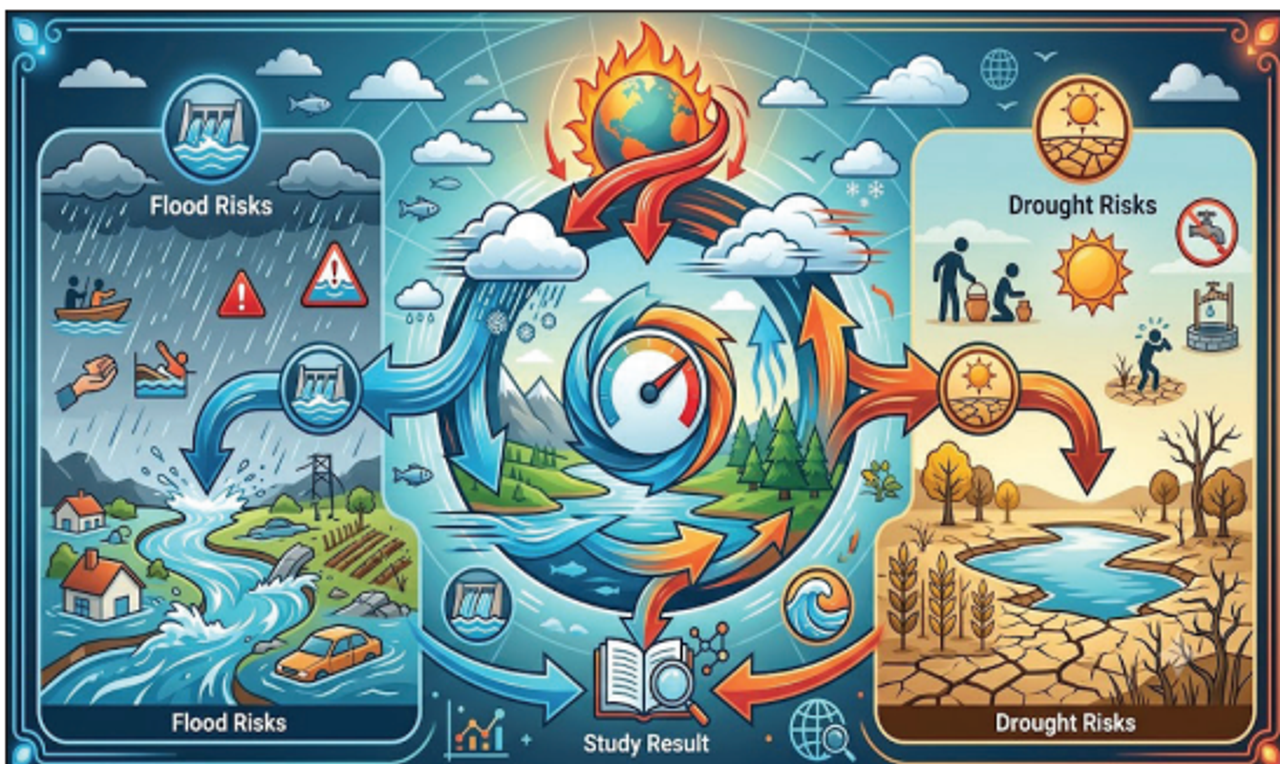
A warmer atmosphere can hold more moisture, and when that moisture converges into storms and monsoon systems, it can provide additional fuel for intense rainfall, cloudbursts and flooding. In contrast, regions experiencing moisture divergence, declining soil moisture or changes in atmospheric circulation could face greater drying and drought risks.
The study identifies significant changes across climate-sensitive regions including the Himalaya–Tibetan Plateau, Amazonia, Central Africa, the Sahel, Sahara and western Pacific.
The Himalaya–Tibetan Plateau, the “Third Pole”, is of particular concern because changes in atmospheric moisture could affect precipitation, snow and glacier processes and river discharge, with implications for water resources supporting millions of people downstream.
The researchers say the uneven response could create a future of “hydrological whiplash” — more intense wet extremes in some regions and periods alongside prolonged drying and water stress in others.
“Water vapour is emerging as a critical link between global warming and future climate extremes,” said S. Sarkar, lead author of the study. “Understanding where atmospheric moisture is increasing and where it is becoming limited is essential for anticipating future risks to water, ecosystems and society.”
India’s monsoon risk
The findings have particular implications for India. The study records increasing atmospheric moisture over major monsoon regions, with TCWV rising by up to about 0.16 mm per year over parts of the Indian monsoon domain.
The increase does not automatically mean higher seasonal rainfall. However, greater atmospheric moisture can provide additional fuel for intense monsoon systems, potentially increasing the ingredients for episodes of very heavy rainfall and flooding.
For India, which is already dealing with combinations of extreme heat, intense rainfall, floods and drought, the researchers say understanding changes in atmospheric moisture will be increasingly important for climate-risk planning.
The contrast between emissions pathways is also significant. Under SSP5-8.5, atmospheric water vapour and associated radiative effects are projected to increase substantially more than under SSP2-4.5, indicating stronger water-vapour feedback and greater intensification of the hydrological cycle.
The study calls for better representation of regional moisture processes and land-atmosphere interactions in climate models, alongside adaptation strategies that account for both extremes.
As the researchers put it, future water security cannot be addressed by preparing for floods and droughts separately: climate change may increasingly bring “too much water, too little water” — and sometimes both.