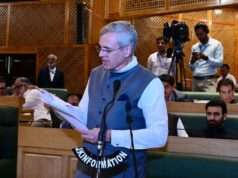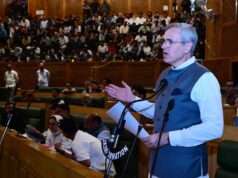

 SRINAGAR, SEPT 28: Jammu and Kashmir Chief Minister Omar Abdullah on Monday introduced key legislative measures in the ongoing Autumn Session of the Jammu & Kashmir Legislative Assembly, including the J&K Goods and Services Tax (Amendment) Bill, 2026 and legislation aimed at strengthening the Ease of Doing Business and Ease of Living framework in the Union Territory.
The Assembly session, which is underway from September 21 to September 30, is witnessing consideration of a range of legislative and policy matters. The official Assembly portal lists the ongoing sitting as the Sixth Session of the First J&K Legislative Assembly.
The J&K Goods and Services Tax (Amendment) Bill, 2026, introduced by Omar Abdullah in his capacity as Minister-in-Charge Finance, seeks to amend the Jammu and Kashmir Goods and Services Tax Act, 2017.
The Bill is listed as L.A. Bill No. 12 of 2026 and had already been published in an extraordinary issue of the Official Gazette before its introduction in the House.
Another major legislative proposal introduced during the day’s business seeks to consolidate and amend provisions relating to ease of doing business and ease of living.
According to the reported legislative text, the measure is aimed at moving from permission-based controls towards rule-based governance, with the stated objectives of enabling citizens and enterprises to plan and invest with greater confidence, facilitating employment generation, attracting investment and supporting long-term economic growth in J&K.
The legislative agenda also included bills concerning amendments to the J&K Ministers’ and Ministers of State Salaries Act, 1956, the Salaries and Allowances of Members of the J&K State Legislature Act, 1960, and the J&K State Legislature Members’ Pension Act, 1984. The official supplementary business list identified these as separate legislative items alongside the GST and ease-of-doing-business measures.
Meanwhile, replying to a Calling Attention Notice, the Chief Minister informed the House that joint teams of the Revenue, Agriculture and Horticulture departments were conducting an on-the-spot assessment of crop damage following a severe hailstorm in Tehsil Kunzer/Tangmarg.
The field assessment is intended to establish the actual extent and nature of damage suffered by farmers and horticulturists in the affected areas. The joint departmental exercise is expected to provide the administration with ground-level information regarding losses to agricultural and horticultural crops and facilitate further action in accordance with applicable relief and assessment norms.
The Government’s approach of deploying Revenue, Agriculture and Horticulture officials together places the assessment at the field level, allowing crop damage to be documented through coordinated inspection rather than relying solely on preliminary reports.
The issue of hailstorm-related crop losses has emerged repeatedly during the current Assembly session.
In an earlier response concerning hailstorm damage in parts of Banakoot Block of Bandipora, the Chief Minister had informed the House that the assessed damage there was below the prescribed 33 per cent threshold for input subsidy under SDRF norms, highlighting the importance of detailed field assessment in determining eligibility for relief.
The latest response on Kunzer/Tangmarg therefore brings both economic legislation and immediate agrarian concerns into focus during the ongoing session, with the Government simultaneously pursuing regulatory reforms in the Assembly and undertaking ground-level assessment of weather-related losses affecting the farming and horticulture sectors.