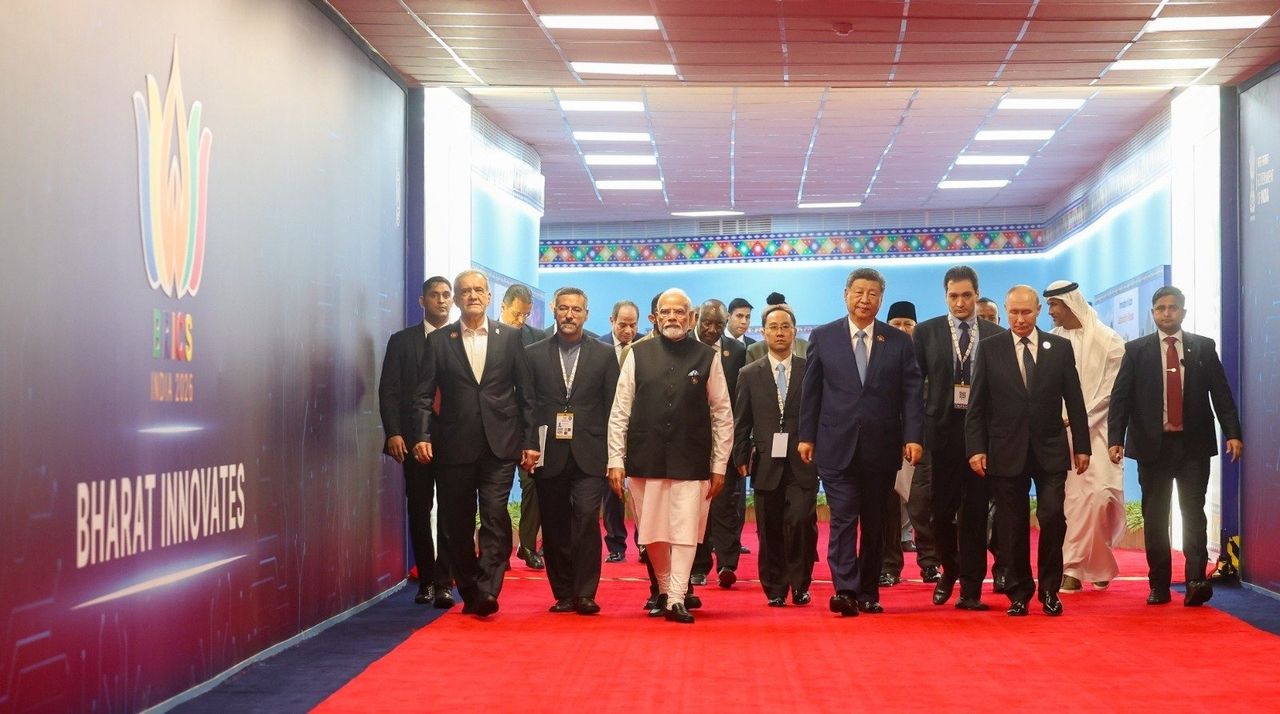

New Delhi, Sep 12: Prime Minister Narendra Modi secured a major diplomatic triumph on Saturday as leaders of the expanded BRICS bloc unanimously adopted the New Delhi Declaration, enshrining support for India’s bid for a permanent seat on the United Nations Security Council, pushing back against Western trade barriers, and initiating concrete moves toward financial clearing mechanisms that bypass the US dollar.
The 140-point joint declaration, agreed on the opening day of the two-day summit at the Bharat Mandapam convention centre, marks the 20th anniversary of the founding of the grouping.
The document capped months of extensive negotiations led by New Delhi across more than 400 meetings in 30 Indian cities, framing India as the central bridge between an increasingly polarized West and a demanding Global South.
Convening under the Indian presidency’s theme ‘Building for Resilience, Innovation, Cooperation and Sustainability,’ the heads of state of the newly expanded bloc issued their most forceful challenge yet to the post-World War II global order.
The communiqué declared that current multilateral architectures are fundamentally misaligned with contemporary multipolar realities and called for structural decentralisation across international politics and finance.
In a direct endorsement of India’s core strategic goal, permanent Security Council members China and Russia explicitly reiterated their backing for the aspirations of India and Brazil to play a greater role in the United Nations, including permanent membership on the Security Council.
The declaration similarly endorsed the legitimate aspirations of African states under the Ezulwini Consensus and Sirte Declaration, demanding that council reform amplify developing voices.
The summit took aim at executive appointments across international bodies, highlighting that in the ongoing selection of the next UN Secretary-General, no woman has ever been elected, while only two nationals from Asia, two from Africa, and one from Latin America have ever held the role.
Invoking Article 101 of the UN Charter, leaders demanded an end to national monopolies over senior executive posts and deplored efforts by certain states to undermine multilateral bodies by deliberately withholding assessed budgetary dues.
Addressing historical injustices, the summit welcomed UN General Assembly Resolution 80/250 declaring the trafficking and racialised chattel enslavement of Africans as humanity’s gravest crime, urged the complete eradication of colonialism under Resolution 79/115, and backed a proposal by South Africa and Brazil to establish an international panel on inequality under Sustainable Development Goal 10.
New Delhi also steered an aggressive critique of international financial architecture. Reaffirming the ‘BRICS Rio de Janeiro Vision’ and the ‘Diriyah Guiding Principles,’ the leaders demanded the immediate implementation of the IMF’s 16th General Review of Quotas and swift realignment under the 17th review.
The declaration insisted that emerging market quota increases must match their true economic weight, without coming at the expense of poorer nations, and warned that voluntary financial contributions must never dictate quota allocation or governance representation.
It also called for open, merit-based leadership selection at the IMF and World Bank to dismantle historical Western appointments.
On trade, the leaders hit out at unilateral protectionism and unilateral carbon border adjustment measures (CBAM), characterizing them as discriminatory distortions violating World Trade Organisation principles.
The bloc demanded the immediate restoration of the WTO’s paralysed dispute-settlement Appellate Body, welcomed the accession procedures of Iran and Ethiopia, and commended China’s zero-tariff programme for 53 African nations.
Extraterritorial sanctions and secondary coercive economic measures drew unanimous condemnation, with leaders warning that such restrictions violate international law, sever critical supply chains, and infringe on fundamental human rights to development.
To shield member states from unilateral financial sanctions, India helped steer tangible economic deliverables aimed at reducing reliance on Western financial plumbing.
The BRICS Payment Task Force was mandated to broaden local currency settlements and test technical interoperability between member states’ domestic interbank messaging networks and central bank payment rails.
Progress was registered on creating a BRICS Insurance Resilience Centre, alongside a review of an Indian proposal to locate an open-access ‘BRICS Risk Lab’ inside the GIFT City International Financial Services Centre in Gujarat.
Members also advanced structural revisions to strengthen liquidity responsiveness under the Contingent Reserve Arrangement Treaty ahead of its ninth operational test run, expanded pilot operations under the BRICS Multilateral Guarantees facility, and drafted steps for a member-driven New Investment Platform.
Catering to India’s substantial small-business sector, the leaders agreed to examine an Indian-championed cross-border Invoice Discounting Mechanism under the ‘Jaipur Consensus’ to provide liquidity for micro, small, and medium-sized exporters.
The summit endorsed operationalising the BRICS Grain Exchange to protect against global food and fertiliser price shocks, and advanced feasibility work on an autonomous, high-speed submarine telecommunications cable network linking members directly.
The New Development Bank, marking its 10th year of operations, was directed to expand local-currency loan disbursements.
On foreign policy and international security, the summit expressed profound alarm over military escalation across the Middle East.
The declaration condemned attacks on civilians, civilian infrastructure, and IAEA-inspected nuclear installations, while demanding immediate compliance with UNSC Resolution 2803 following violations of the October 2025 Gaza ceasefire agreement.
The leaders rejected any demographic alterations or forced displacement of Palestinians, insisted on full humanitarian access via UNRWA, and called for the admission of the State of Palestine as a full U.N. member based on pre-1967 borders with East Jerusalem as its capital.
The communiqué also condemned breaches of Lebanese sovereignty under UNSC Resolution 1701, demanding complete Israeli military withdrawal, and strongly condemned strikes against the UN Interim Force in Lebanon (UNIFIL) that resulted in the deaths of four Indonesian peacekeepers.
BRICS called for the total withdrawal of unauthorised foreign forces occupying Syrian territory under UNSC Resolution 2254, urged an immediate, permanent ceasefire in Sudan under the principle of ‘African solutions to African problems,’ and called for the prompt termination of unilateral economic embargoes against Cuba.
On security, Indian negotiators secured unified language unequivocally condemning terrorism in all forms, specifically citing the April 2025 terrorist attack in Jammu and Kashmir.
The declaration demanded zero tolerance, rejected double standards, urged coordinated crackdowns on UN-designated terrorist outfits, and pressed for the adoption of the Comprehensive Convention on International Terrorism.
The summit also pledged intelligence-sharing between financial intelligence units to combat cyber scam syndicates, illicit virtual asset exploitation, and international arms trafficking.
The document codified wide-ranging operational initiatives across technical sectors, approving an Integrated Early Warning System for Mass Infectious Diseases, pharmaceutical regulatory integration under the BRICS GXP White Paper, and a mental health network anchored by India’s National Institute of Mental Health and Neurosciences (NIMHANS).
Marking the 65th anniversary of Yuri Gagarin’s space flight, the bloc amended its Remote Sensing Satellite Constellation framework to integrate new member space agencies, drafted Terms of Reference for a BRICS Space Council, and reiterated calls for a binding treaty prohibiting outer-space weapons.
Leaders approved a joint declaration on the global governance of artificial intelligence, created the BRICS Incubator Network, and began reviews for a shared startup innovation fund.
The declaration codified the Strategy for BRICS Economic Partnership 2030, establishing unified norms for green hydrogen certification, smart grids, and gig-worker social protections through the newly established BRICS CONNECT initiative.
Following the conclusion of the New Delhi summit, India will formally hand over the rotating BRICS chairship to China, which will host the 19th summit in 2027.