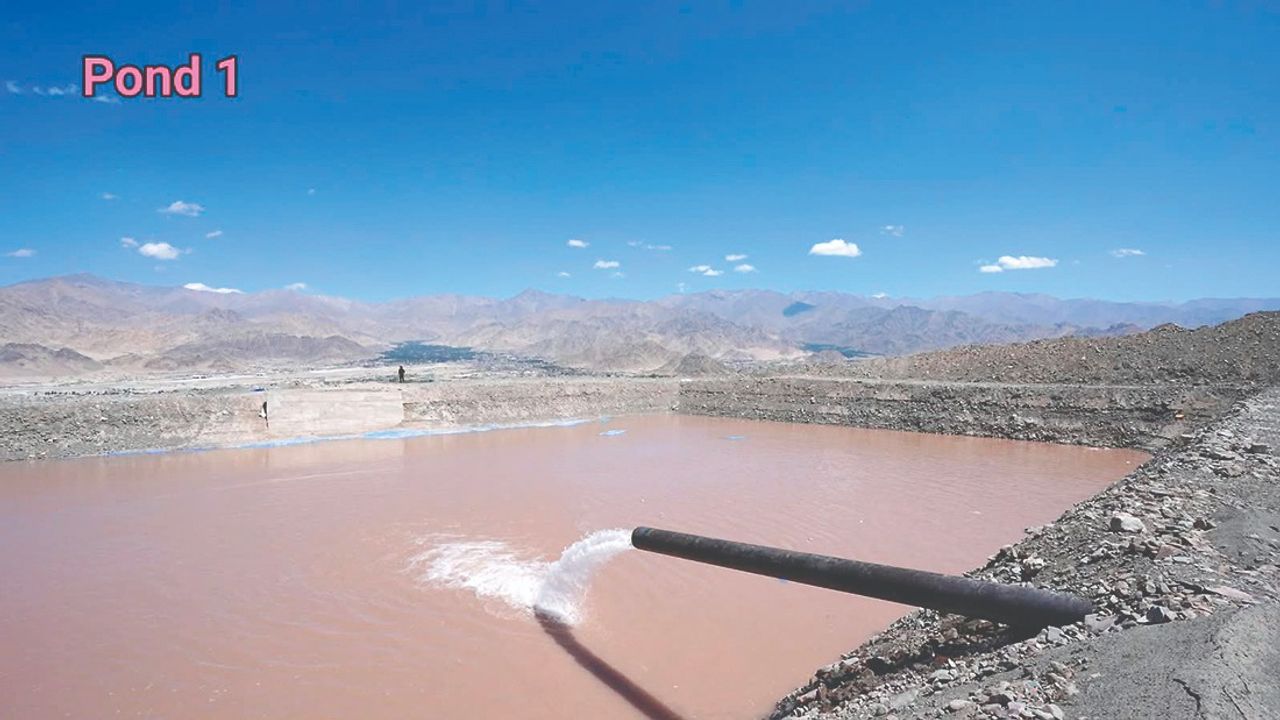

Srinagar, Sep 16: Project Him Sarovar, a Ladakh-wide initiative to conserve seasonal snow and glacier meltwater for irrigation and long-term water security, has completed four large ponds at SpitukFarka in Leh.
“With immense delight and satisfaction, I share that all four large ponds, constructed under Project Him Sarovar at SpitukFarka in Leh, have now been filled with glacier meltwater, in a record time of just five months,” Lieutenant Governor (LG) LadakhVinai Kumar Saxena said in a post on X.
Construction of the four ponds began on April 10, and the fourth was recharged and operationalised on September 9.
Pond No. 1 was inaugurated on June 21, Pond No. 2 was filled on July 19, Pond No. 3 on August 24 and Pond No. 4 on September 9.
Each pond measures 60 metres by 40 metres and is two metres deep, with a capacity of about 60 lakh litres.
Together, they can store nearly 24 million litres and create an irrigation command area of nearly 1,000 acres.
The ponds are fed by seasonal flows from the Stok glacier stream, diverted through the Igoo-Phey Canal.
“This diversion ensures that huge volumes of water, earlier wasted, are now conserved for irrigation, ecological restoration, and long-term water security,” Saxena said.
He said the initiative would support environmental resilience, agricultural revival and sustainable water security in Ladakh’s cold desert.
What is Project Him Sarovar?
The project aims to create 100 water bodies across Ladakh within a year. The first phase covers 50 sites – 30 in Leh and 20 in Kargil.
Ladakh receives little rainfall and depends heavily on snow and glaciers. Much of its water becomes available during the short summer melt season, while shortages persist for much of the year.
The project seeks to retain this seasonal water closer to villages and agricultural areas for use beyond the melt season.
Building on local water systems
The initiative builds on existing water-conservation efforts.
At Stok, a heavily silted natural depression was restored into a reservoir spread over 1,824 square metres. It can store nearly 35 lakh litres and support irrigation over about 150 hectares.
At Matho, an existing pond was cleaned and rejuvenated, increasing its capacity from about 1.5 crore litres to 2.5 crore litres.
Ladakh has also used artificial glaciers and ice stupas to retain winter water for agriculture.
Multi-agency effort
The programme involves government departments, the Army, ITBP, BRO and local communities.
Sites are selected based on local water needs, terrain and seasonal flows.
The stored water can support irrigation, plantation and ecological restoration, while some sites can also provide opportunities for recreation and local livelihoods.