

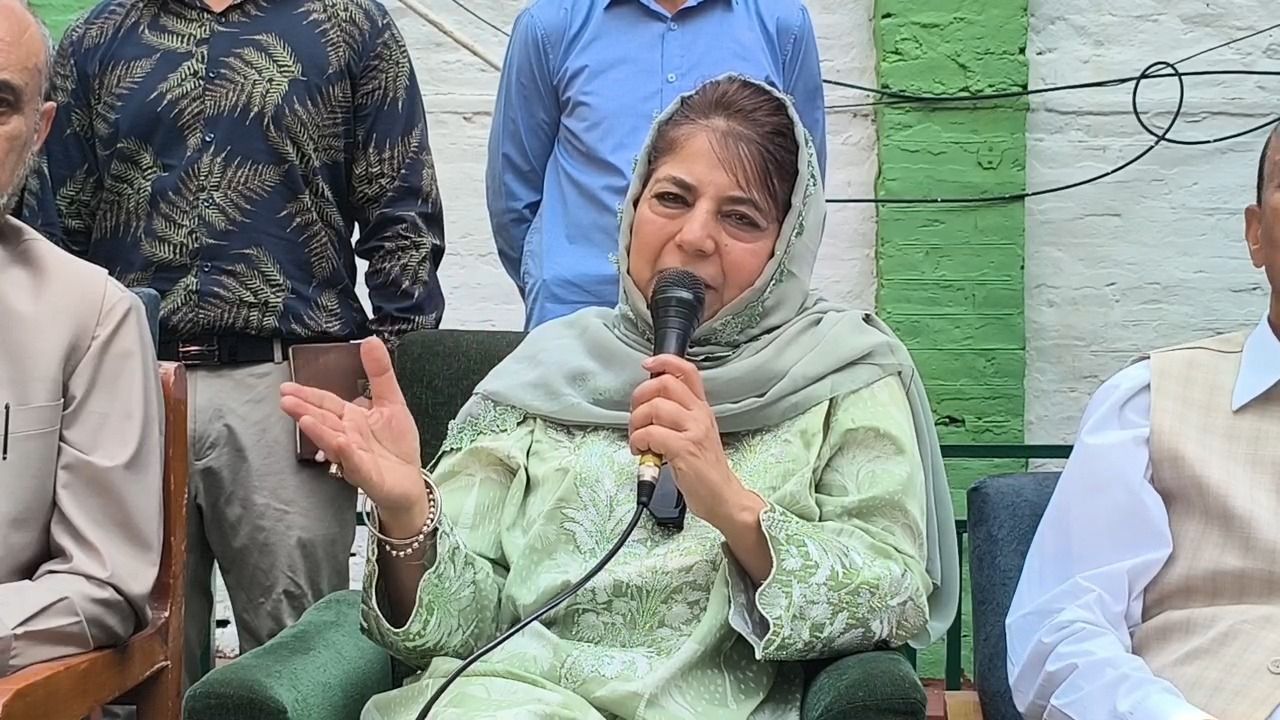


Srinagar, Sep 12: Peoples Democratic Party (PDP) president Mehbooba Mufti has welcomed the BRICS condemnation of the Pahalgam terror attack, while questioning why India, as the current chair of the grouping, did not use the opportunity to push for a stronger and more comprehensive position against violence and civilian suffering across the world.
The 18th BRICS Summit, hosted by India in New Delhi, adopted the New Delhi Declaration, which strongly condemned the April 2025 Pahalgam terror attack, reaffirmed a policy of zero tolerance towards terrorism and called for concerted action against terrorism in all its forms, including terrorist financing and safe havens.
Welcoming the condemnation, Mufti said India, as the chair of BRICS, should also have demonstrated “courage and true leadership” by ensuring that the collective statement unequivocally addressed the devastation in Gaza and the US-Israeli military action against Iran.
“Terrorism cannot be condemned selectively. Civilian blood has no nationality, and international justice cannot have double standards,” Mufti said.
She stressed that the principle of condemning attacks on civilians must remain universal and should not depend on the nationality, religion or geopolitical alignment of those affected.
The BRICS declaration expressed deep concern over the continuing escalation in West Asia, called for maximum restraint and urged that disputes be resolved through dialogue, consultation and diplomacy. It also emphasised the protection of civilians and civilian infrastructure and raised concerns over attacks involving peaceful nuclear facilities.
Mufti said these commitments should be applied consistently.
“If the international community is serious about ending terrorism and protecting civilians, there can be no hierarchy of victims and no selective outrage,” she said.
She also welcomed the BRICS call for humanitarian assistance to Gaza, while asserting that humanitarian relief alone cannot substitute for accountability and an end to the violence. The declaration supports humanitarian assistance to Gaza, while its broader language on West Asia calls for restraint, civilian protection and adherence to the UN Charter.
“The suffering of civilians in Pahalgam, Gaza or Iran cannot be viewed through different moral or political lenses. The same standard must apply to every human life. The credibility of multilateral institutions depends on their ability to uphold this principle without fear or favour,” Mufti said.
She added that India’s leadership of BRICS offered an important opportunity to strengthen the voice of the Global South by advocating a consistent, rules-based international order in which terrorism, attacks on civilians and violations of international law are condemned irrespective of who commits them.
“India should lead by example. If civilian blood has no nationality, then justice cannot have double standards either,” Mufti said.


