
Srinagar, Sep 17: The proposed Merchant Discount Rate (MDR) on certain UPI payments above Rs 2,000 has triggered concern among traders in Kashmir, who fear that the move could add to the cost of running small businesses at a time when margins are already under pressure.
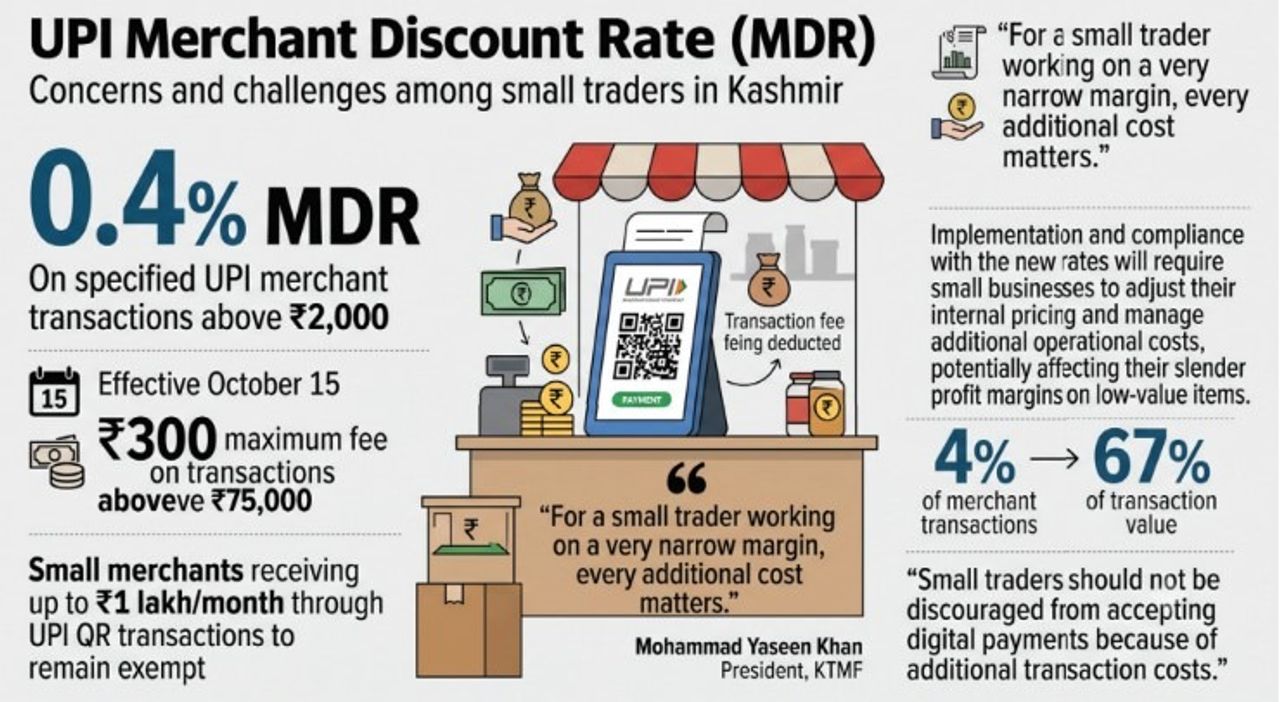
Under the revised framework, a 0.4 per cent MDR is set to apply from October 15 to specified person-to-merchant UPI transactions above Rs 2,000. The charge will be borne by the merchant and not the customer. The fee will be capped at Rs 300 for transactions above Rs 75,000, while small merchants receiving up to Rs 1 lakh a month through UPI QR transactions are to remain exempt.
The proposed change marks a departure from the zero-MDR regime that has been a major feature of UPI since its rapid expansion. While most UPI transactions will continue to remain free, the new charge is expected to affect a relatively small share of merchant transactions but a much larger proportion of their value. Industry estimates suggest transactions above Rs 2,000 account for around 4 per cent of merchant transaction volumes but about 67 per cent of transaction value.
For traders in Kashmir, the concern is over the cumulative impact on businesses that already face rising rents, electricity bills, wages, taxes, compliance costs and other operating expenses. Small retailers, in particular, say even a modest charge on repeated digital transactions can eat into margins when business volumes are high but profitability remains limited.
The Kashmir Traders & Manufacturers Federation (KTMF) has urged the Government of India to reconsider the proposed MDR and ensure that small and marginal traders are not adversely affected.
KTMF President Mohammad Yaseen Khan said the Federation appreciated the Government’s efforts to strengthen and expand the digital payment ecosystem, but maintained that the concerns of small retailers and businesses operating on thin margins could not be overlooked.
“For a large corporate or high-volume business, a small percentage may appear insignificant, but for a small trader working on a very narrow margin, every additional cost matters. Traders are already dealing with multiple taxes, compliance requirements, rising operational expenses, high rentals, electricity costs, staff expenses and weak consumer demand. Another transaction-related cost will only add to their burden,” Khan said.
He said the widespread acceptance of UPI had been built on its simplicity and zero-cost character and cautioned against measures that could discourage traders from accepting digital payments.
“The success of UPI has been built on its simplicity and zero-cost character. Small traders should not be discouraged from accepting digital payments because of additional transaction costs. A retailer should be encouraged to accept digital payments, not made to calculate the cost of every transaction,” Khan said.
KTMF has particularly sought protection for micro and small traders whose businesses depend heavily on UPI but operate with limited margins. The Federation has also sought greater clarity and a wider exemption mechanism so that genuine small businesses do not inadvertently fall outside the protection available under the new framework.
Khan said the trading community had consistently supported digitalisation and formalisation of the economy, but wanted the interests of smaller businesses to be considered while framing the new payment regime.
“The traders community has always supported digitalisation and formalisation of the economy. We only request that the interests of the smallest trader, from the shopkeeper to the family-run retail outlet, be kept at the centre of policymaking. Their margins are already under tremendous pressure and even a small additional cost can have a disproportionate impact,” he said.
KTMF urged the Union Government to consult representative trade bodies before expanding or revising MDR charges and ensure that small and marginal traders remain financially viable as digital payments continue to grow.