



Srinagar, Sep 9: With the suspension of strike and protest of MBBS interns in GMCs of J&K, a workforce has re-entered the strained pool of healthcare workers in hospitals.
However, with the limited time, yet significant strike of NHM employees, patient services are on the brink again.
J&K’s public healthcare system is under disruption once more.
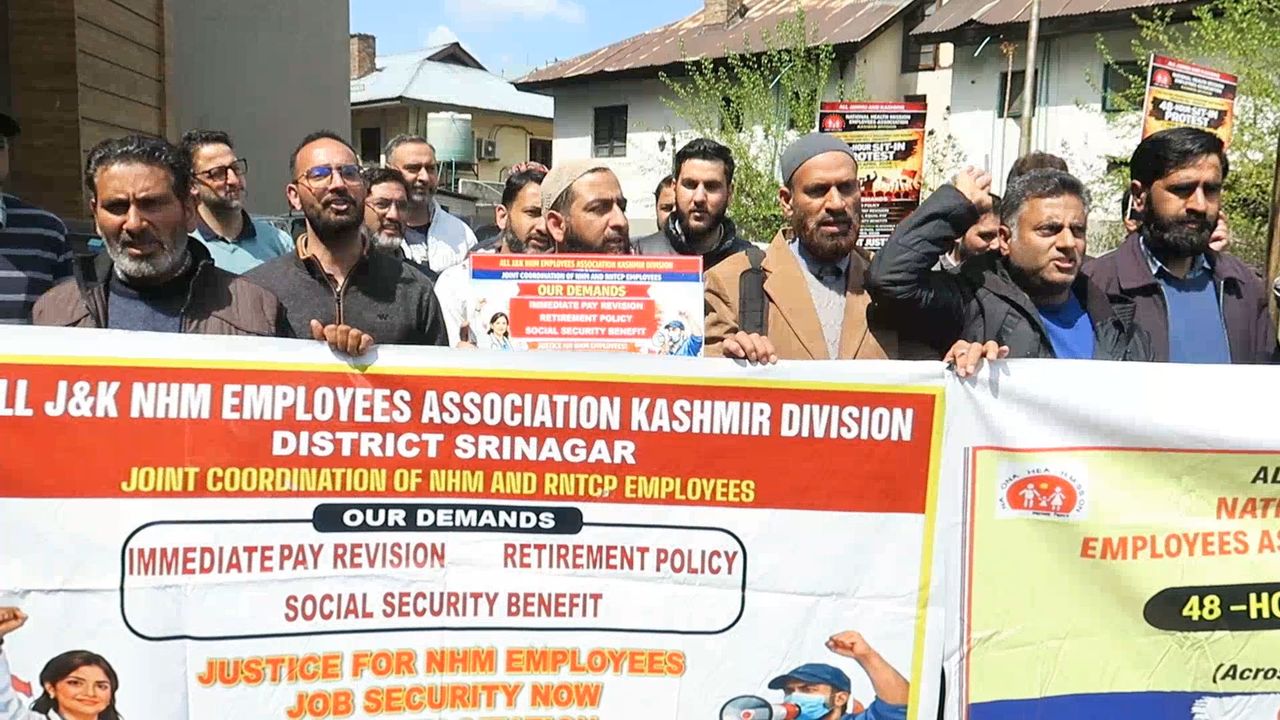
The National Health Mission (NHM) employees across J&K, their numbers running into at least 11,000 in Kashmir division, have begun a 72-hour strike from September 9. NHM staff forms one of the largest pools of healthcare workforce in J&K.
Their portfolio includes immunisation, mother and child health services and other disease control programs.
Their concentration in peripheral areas keeps the healthcare delivery smooth, and healthcare schemes available to masses.
The health sector in J&K continues to face a striking gap between sanctioned manpower and actual staffing.
By government’s own figures, nearly 16,000 posts are lying vacant across the Health and Medical Education Department.
The shortage is not limited to doctors: thousands of paramedical and non-gazetted posts are also unfilled.
In the absence of timely regular recruitment, the system leans heavily on NHM and academic and contractual arrangements to keep hospitals functioning.
Young medical and paramedical professionals are pushed towards contractual NHM appointments or other relatively less secure positions.
They continue to wait for advertisements of sanctioned government posts lying vacant, and cross the age of eligibility in waiting.
The NHM association has said the government had failed to respond to a “final ultimatum” set for September 5.
The committee said the strike would cover all district, block and field-level NHM staff, and across health facilities, across the J&K.
Spokesperson of J&K NHM Employees Association (JKNHMEA), Abdul Rauoof said that many of the NHM employees were serving for nearly 18 years without a comprehensive regularisation or job-security framework.
He said the workforce had contributed significantly to J&K healthcare delivery and their demands were “most genuine”.
The demands of the association include a time-bound process for regularisation and long-term job security of eligible NHM employees.
They have also demanded “equal pay for equal work”, in addition to the extension of 7th Pay Commission benefits to eligible NHM staff. Furthermore, a financial assistance of Rs 30 lakh to the family of an NHM employee who dies in service also features in the list of demands.
In April this year, NHM employees went on strike, but called off the stir only after a day following assurances from the government.
“They told us our demands are genuine, and that these will be addressed within two months. However, five months have passed, and we don’t see any progress,” a representative of NHM employees told Greater Kashmir.
“We are not left with any option but to strike,” he said.
Earlier, the MBBS and BDS interns across J&K’s government medical colleges began an indefinite strike around August 31.
They demanded that their monthly stipend be raised from Rs 12,300 to Rs 30,000.
Interns said the stipend has not been revised in nearly seven years and is far less than what their counterparts are paid in medical colleges in other states of India.
A committee formed by the Health and Medical Education Department in 2023 had recommended raising the stipend to around Rs 25,000.
However, no order has been issued to implement it.
Interns have been alleging that they are being redirected between the Chief Minister’s office and the Finance Department. However, on Tuesday the Health and Medical Education Department promised a solution within 30 days, prompting an end to the strike by interns.


