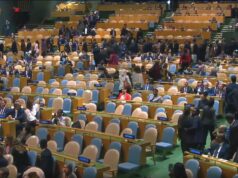
United Nations, Sep 25: Nepal Prime Minister Balendra Shah has proposed establishing a Himalayan Climate Resilience Mechanism led by his country as well as India and China, in the wake of the recent devastating flash floods in the area.
Shah, in his maiden address to the 81st session of the UN General Assembly on Thursday, also told world leaders that a warming climate is destabilising the fragile Himalayan ecology.
“The Hindu Kush Himalaya is home to nearly two billion people. These mountains provide water, ecosystems, agriculture and livelihoods to populations far beyond Nepal. The Himalayas are not peripheral to the planet. They are part of the planet’s life-support system,” Shah said.
“That is why, as an urgent first step, we propose that we establish a Himalayan Climate Resilience Mechanism, led by Nepal, India and China,” Shah said.
He said the mechanism should be used to share satellite data and expertise. Through this mechanism, let us share satellite data and expertise.
“Let us monitor dangerous glacial lakes. Let us strengthen joint early-warning systems. And when disaster strikes, let us coordinate assistance across borders. Let the Himalayas become a laboratory of international cooperation, rather than a frontier of fragmented information,” he said.
“Melting permafrost is fracturing mountain slopes beneath the glaciers and accelerating the risks of ice-rock avalanches, floods, landslides and other cascading hazards. The resulting devastation unleashed havoc on both sides of the Nepal-China border. The flood continued downstream towards India,” he said.
Shah said the devastating Nepal floods gave the world a fundamental message that “Climate change does not recognise borders. Glaciers and floods do not travel with a visa stamped on passports.”
Shah expressed Nepal’s deep gratitude to the countries who came to its aid in the aftermath of the deluge.
Nepal was struck by a massive flash floods, triggered by an ice-rock avalanche near the Nepal-Tibet border on August 26. The floods devastated towns and villages in northern and central Nepal.
The death toll from the devastating flood has reached 1,452, with over 4,700 to 6,000 people still reported missing.
Nepal Prime Minister Shah told the UN that Nepal now faces a massive task of recovery and reconstruction. Rapid assessments peg physical recovery needs at about 10 percent of GDP, he said.
“Our immediate neighbours, India and China, offered prompt and generous assistance. Other friendly countries, the United Nations system, humanitarian agencies, philanthropies and people around the world stood with Nepal,” he said.
He said that on the one hand, there are melting glaciers and failing harvests to floods arriving without warning. On the other, a global supply chain punishes poor people for causes beyond reason.
“Inter-continental missiles arrive on time. Rifles and ammunition cross borders, clear every bottleneck, meet each deadline. But a peasant in Nepal cannot procure his fertilizer or fuel at market price at a time of need.
“We have built a world with flawless logistics for war and broken logistics for food.
“And this is not Nepal’s private misfortune. Ask Bangladesh. Ask Bhutan. Ask India. Ask the Maldives. Ask Pakistan. Ask Sri Lanka. Ask any other country in our region and you will hear the same account: hit by the climate we did not warm, and hit again by the wars we did not start. This tells us there is a lot more broken than meets the eye in the present order of global cooperation,” he said.