
 LEH, OCT 7: Lieutenant Governor Vinai Kumar Saxena on Wednesday flagged off India’s First High-Altitude Wildlife Safari dedicated to snow leopards in Ladakh, launching a conservation-linked tourism initiative aimed at protecting fragile Himalayan habitats while creating sustainable livelihood opportunities for local communities.
The first fleet of six specially designed safari vehicles was flagged off at Choglamsar Protected Forest during the Wildlife Week 2026 celebrations. The initiative has been launched by the Snow Leopard and High-Altitude Nature Conservation (SHAN) Society) in collaboration with the Department of Forest, Ecology and Environment, UT Ladakh.
The safari will initially operate across Rumbak, Shang and Uley, areas known for frequent snow leopard sightings. Specially designed open-back vehicles, trained local drivers and wildlife guides will facilitate regulated tours, allowing visitors to experience Ladakh’s high-altitude wildlife while limiting disturbance to sensitive habitats.
The programme is planned for expansion across Hemis National Park, Changthang and Karakoram Wildlife Sanctuary, besides wildlife-rich landscapes in Nubra, Zanskar, Sham, Kargil and Drass.
Addressing the gathering, Saxena stressed that wildlife tourism must be developed within a conservation framework, saying the objective was not simply to increase tourist numbers but to establish a model of regulated and responsible tourism that enables both wildlife and local communities to thrive.
Under the initiative, visitor numbers will be regulated, routes will be approved and trained local personnel will operate the safari services. The administration said these measures would help reduce disturbance to wildlife, discourage illegal off-roading and simultaneously create direct livelihood opportunities for residents.
Ladakh is home to the country’s largest population of snow leopards, with 477 animals recorded in the region out of an estimated national population of around 718, according to the administration. The UT also supports more than 38 mammal species and over 340 bird species, underlining its importance as a high-altitude biodiversity landscape.
The initiative places community participation at the centre of wildlife tourism. Twenty local youth are being trained in bird identification, birdwatching and wildlife spotting, creating opportunities for them to work as wildlife guides, bird guides, nature interpreters and eco-tourism entrepreneurs.
Saxena also highlighted conservation-linked livelihood initiatives, including a Wild Animal Felting Programme involving 50 women from different parts of Ladakh, aimed at linking conservation efforts with income-generating opportunities.
As part of the conservation education component, cheques were handed over to the Chief Education Officers of Leh and Kargil for distribution among 50 schools for conservation education through Eco Clubs supported by SHAN Society.
The event also witnessed the inauguration of an AI-based human-wildlife conflict mitigation device, developed by the Wildlife Division, Kargil, in collaboration with the University of Ladakh’s Kargil Campus. The technology-based intervention is aimed at strengthening efforts to manage interactions between communities and wildlife.
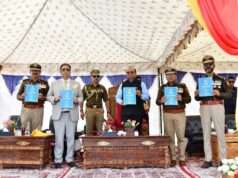
The Lieutenant Governor also released a documentary on the Himalayan Brown Bear and a brochure detailing wildlife tourism packages offered by SHAN Society. The second edition of the Ladakh Black-necked Crane Festival was also announced during the event.
The administration said the decision to introduce wildlife safaris in Ladakh was announced on August 5, 2026, and the initiative has been operationalised within two months, reflecting a coordinated effort to translate the conservation-tourism plan into a field-level programme.
The launch marks a significant step towards positioning Ladakh’s exceptional wildlife as part of a regulated, community-oriented and conservation-driven tourism model, while strengthening awareness, local participation and protection of some of the region’s most fragile high-altitude ecosystems.